
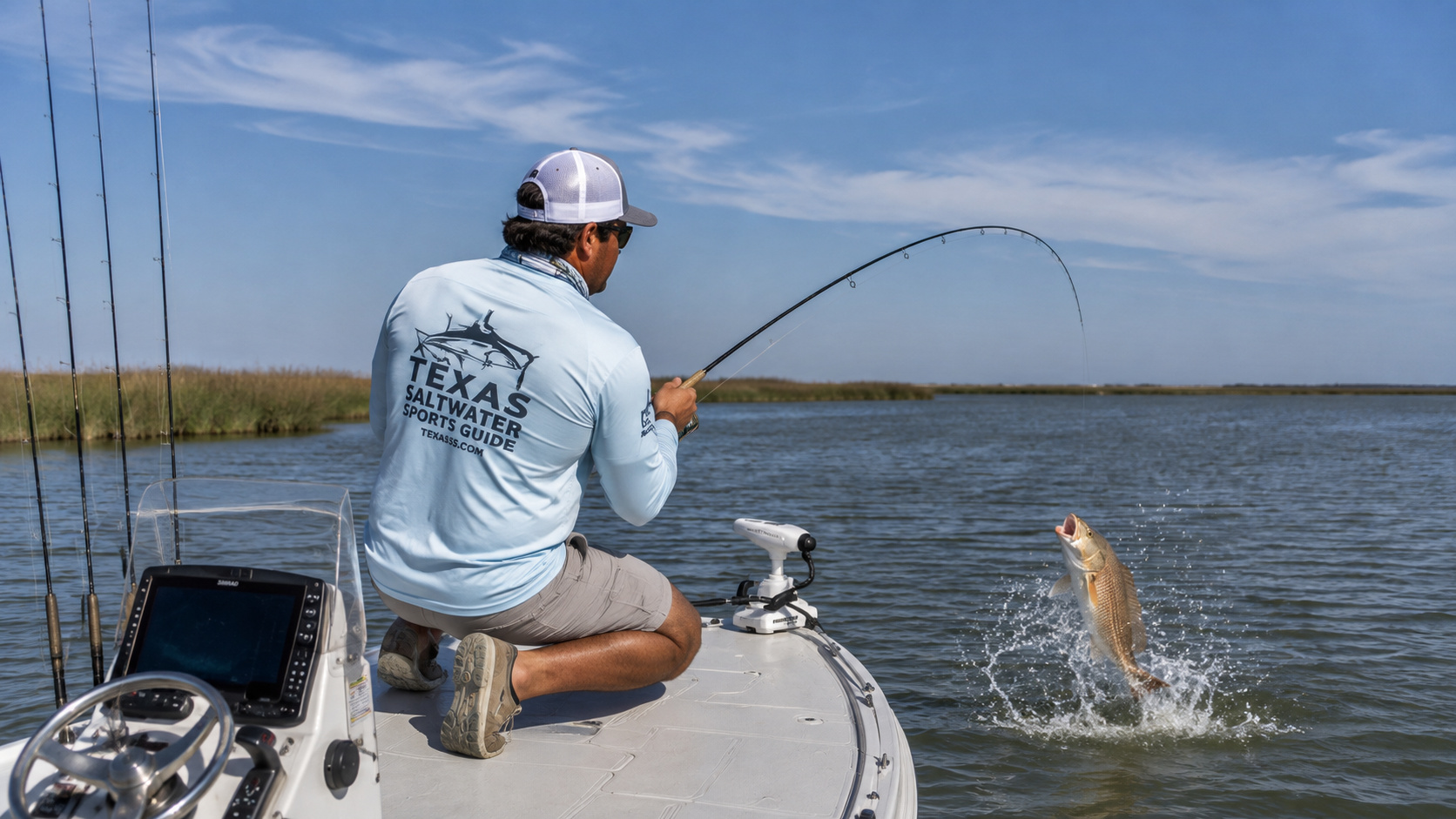
There are fish you catch, admire for a minute and remember fondly.
Then there are redfish.
Hook a good red in two feet of Espiritu Santo Bay water and there isn't much mystery about what has happened. The rod bows toward the Gulf, the drag starts singing, and that broad copper fish heads off across the flat with all the determination of a Brahma bull that just discovered somebody left the gate open.
I've loved that kind of fishing for most of my life.
Maybe it is because shallow-water redfish combine so many things that make fishing interesting. You aren't merely throwing a lure into water and hoping. You're reading wind, current, grass, shell, birds, mullet and subtle changes in water color. Sometimes you're looking for the fish themselves.
A tail appears.
A wake moves along the grass.
Mullet suddenly scatter.
You make one cast.
And the whole quiet morning explodes.
That is How to Catch Redfish in Espiritu Santo Bay Texas in its purest form.
But there is much more to this bay than one cast.
So pour another cup of coffee and let's take a good look at one of the finest stretches of redfish country on the middle Texas coast.
Where Is Espiritu Santo Bay Texas?
Espiritu Santo Bay lies on the middle Texas coast near Port O'Connor, between the greater San Antonio Bay and Matagorda Bay systems.
Matagorda Island forms much of its southeastern boundary and separates the protected bay environment from the open Gulf of Mexico.
The bay is roughly 16 miles long and about five miles wide, although defining its fishing water by a simple acreage figure is difficult because it connects with marshes, lakes, channels, the Gulf Intracoastal Waterway, San Antonio Bay and Pass Cavallo.
This isn't a neat little reservoir surrounded by shoreline.
It is an estuary.
Water comes and goes. Salinity changes. Wind moves tremendous amounts of water. Fish travel between marshes, reefs, bays and passes.
That mobility is the secret to understanding Espiritu Santo Bay redfish.
How Deep Is Espiritu Santo Bay?
Much of the bay is shallow.
Typical fishing water ranges from roughly one to six feet, although navigation channels, passes and portions of the Intracoastal Waterway are considerably deeper.
For redfish anglers, shallow water is good news.
A one-foot depth change may be meaningful.
So might a six-inch depression in a flat.
The bottom contains combinations of:
-
Sand
-
Mud
-
Shell
-
Oyster reef
-
Seagrass
-
Marsh edges
-
Tidal drains
Each can hold redfish under the right conditions.
What Rivers Feed Espiritu Santo Bay?
Espiritu Santo Bay belongs to the larger Guadalupe Estuary system.
Its primary freshwater influence ultimately comes from the Guadalupe and San Antonio rivers, which feed the connected San Antonio Bay system.
Freshwater inflow matters enormously.
Rainfall changes salinity.
Salinity affects shrimp and baitfish distribution.
Bait distribution affects redfish.
After periods of heavy freshwater runoff, fish may reposition toward areas with greater salinity. During prolonged dry periods, saltier Gulf water can penetrate farther into the estuary.
A fisherman who watches rainfall as carefully as tides has already learned something important about coastal fishing.
Fish Species in Espiritu Santo Bay
Red drum may be today's star attraction, but they have plenty of company.
Anglers can encounter:
-
Redfish
-
Speckled trout
-
Southern flounder
-
Black drum
-
Sheepshead
-
Sand trout
-
Croaker
-
Whiting
-
Jack crevalle
-
Gafftop catfish
-
Hardhead catfish
-
Spanish mackerel closer to Gulf-connected water
-
Sharks during warmer periods
The surrounding ecosystem also supports shrimp, blue crabs, mullet, pinfish and other forage species essential to healthy redfish populations.
Texas Parks and Wildlife identifies redfish, sea trout, black drum and flounder as predominant species around Matagorda Island.
That's a pretty respectable neighborhood.
Port O'Connor: Headquarters for Espiritu Santo Bay Redfish Fishing
For most visiting fishermen, Port O'Connor is the logical jumping-off point.
The community sits beside the Gulf Intracoastal Waterway and provides access toward Espiritu Santo Bay, Matagorda Island, Pass Cavallo and surrounding marsh country.
It is still very much a fishing town.
Before sunrise you'll see trailers rolling toward ramps, guides loading ice and bait, and fishermen carrying coffee cups large enough to survive until lunch.
The Fishing Center
Address: 1303 Water Street, Port O'Connor, TX 77982
Phone: 361-983-4440
Email: Contact through the business website
Services: Bait, boat ramp, parking, boat slips, provisions and RV facilities
The Fishing Center is also identified by TPWD as an access point for the Port O'Connor Paddling Trail.
Froggie's Bait Dock
Address: 2649 Stella Avenue, Port O'Connor, TX 77982
Phone: 361-983-4466
Email: No reliably published general email located; telephone confirmation recommended
Services: Live bait, fishing supplies and boat launching
Because bait availability changes with weather and season, call ahead if your fishing plan depends upon live shrimp or mullet.
Boat Ramps and Access
The Fishing Center Boat Ramp
Address: 1303 Water Street, Port O'Connor, TX 77982
Phone: 361-983-4440
This privately operated ramp provides convenient access to Port O'Connor waters.
Froggie's Bait Dock Ramp
Address: 2649 Stella Avenue, Port O'Connor, TX 77982
Phone: 361-983-4466
A convenient choice when you want bait and launching facilities in one stop.
Little Jetties Public Access
Location: Washington Street at the Gulf Intracoastal Waterway, Port O'Connor
Texas Parks and Wildlife identifies this as public right-of-way access. The Pass Cavallo paddling route begins from this general area.
Kayakers should exercise particular caution around commercial vessel traffic and strong current.
Matagorda Island WMA
Matagorda Island Wildlife Management Area lies approximately seven miles across Espiritu Santo Bay from Port O'Connor.
There is no state ferry service.
Access is by private or charter boat.
TPWD specifically permits bank and shallow-water fishing and wade fishing on the Espiritu Santo Bay side of the island.
Lodging Around Port O'Connor
Redfish Lodge Port O'Connor
Address: 710 W. Madison Avenue, Port O'Connor, TX 77982
Phone: 866-903-7742
Email: redfishlodgepoc@gmail.com
Redfish Lodge caters directly to fishermen and outdoor visitors and provides truck and trailer parking.
Poco Loco Lodge
Address: 305 W. Adams Avenue, Port O'Connor, TX 77982
Phone: 361-983-0300
Email: team@staypocoloco.com
Port O'Connor Rentals
Address: 36 Cemetery Street, Port O'Connor, TX 77982
Phone: 361-759-4371
Email: info@pocrentals.com
Vacation houses and condos can be particularly convenient for several fishermen traveling together.
Small coastal businesses sometimes change ownership, contact information and seasonal hours, so always confirm reservations, ramps and bait availability before making a long drive.
Driving Distance to Espiritu Santo Bay
Port O'Connor makes the best practical destination for calculating driving distances.
Austin to Port O'Connor
Approximately 175 miles.
Allow roughly three hours.
A practical route follows US-183 south toward Victoria and then TX-185 through Seadrift to Port O'Connor.
Corpus Christi to Port O'Connor
Approximately 90 miles.
Allow 1½ to 2 hours.
Travel generally follows US-181 and TX-35 toward the Port Lavaca/Seadrift area before connecting with TX-185.
Houston to Port O'Connor
Approximately 160 miles.
Allow about three hours.
A common route follows I-69/US-59 toward Victoria before continuing toward the coast and TX-185.
San Antonio to Port O'Connor
Approximately 155 miles.
Allow about three hours.
US-87 toward Victoria followed by TX-185 provides a practical route.
Dallas to Port O'Connor
Approximately 390 miles.
Plan on roughly 6½ to 7 hours depending upon traffic.
Fort Worth to Port O'Connor
Approximately 380 miles.
Again, allow around 6½ hours.
Always check current navigation and road conditions before departure.
Weather and Redfish Fishing
Espiritu Santo Bay is fishable year-round, but every season has its own personality.
Spring Redfish: Warming Flats
March, April and May bring warming water and increasing bait activity.
Look for reds moving onto:
-
Shallow mud and shell
-
Grass shorelines
-
Back lakes
-
Marsh drains
-
Protected flats
Spring southeast winds can become strong.
Instead of fighting the wind, use it.
Wind pushing water and bait against a shoreline can produce outstanding redfish fishing, provided the water isn't turned completely to mud.
Live shrimp under popping corks, paddle tails and gold spoons are reliable choices.
Summer: Sunrise on the Flats
Summer is when the alarm clock earns its keep.
Launch before daylight.
As sunrise begins coloring the eastern sky, concentrate on shallow grass and marsh shorelines.
Look for:
-
Tailing reds
-
Wakes
-
Nervous mullet
-
Shrimp jumping
-
Mud boils
-
Birds hovering over bait
Topwaters can produce spectacular strikes early.
Once sunlight becomes stronger, switch to weedless plastics, spoons or subtle natural-colored baits.
During the hottest part of the day, reds may seek slightly deeper channels or shaded/current-swept structure.
Fall: Prime Time for Texas Redfish
September through November is hard to beat.
Cooling temperatures activate bait.
Mullet become abundant.
Redfish school.
Some larger fish begin moving toward Gulf passes as spawning activity increases.
This can be a wonderful time to find groups of fish pushing water across open flats.
Gold spoons and paddle tails are nearly mandatory equipment.
Keep a topwater ready, too.
Winter: Follow the Warmth
Winter rewards patient fishermen.
A strong norther can push water out of shallow flats with astonishing speed.
When that happens, don't stubbornly fish yesterday's shoreline.
Move toward:
-
Guts
-
Drains
-
Deeper holes
-
Channels
-
Mud and shell
TPWD's February 2026 San Antonio Bay report noted exactly this pattern: high winds blowing water out of back lakes and flats concentrated redfish and trout in guts and deeper holes. The same report advised finding mullet to find fish.
That's excellent advice on Espiritu Santo Bay as well.
Following a few sunny winter afternoons, dark mud flats warm faster than surrounding water.
Redfish notice.
Where to Catch Redfish in Espiritu Santo Bay Texas
Matagorda Island Shoreline
The Espiritu Santo side of Matagorda Island offers miles of shallow habitat.
Look for grass, sand pockets, small drains and concentrations of mullet.
A quiet approach is essential.
Shut down the Yamaha well before reaching your target and finish the approach with the trolling motor or push pole.
Marsh Drains
A falling tide turns a marsh drain into a cafeteria door.
Shrimp, small crabs and baitfish are pulled from flooded marsh habitat.
Redfish frequently position just outside the drain.
Don't cast directly into the middle every time.
Work both edges.
A good red may be sitting in six inches of additional depth beside the main flow.
Grass Shorelines
Grass edges are classic redfish territory.
Cast parallel rather than continually casting perpendicular to shore.
Keeping the lure in productive water longer increases your odds.
Oyster Reefs
Reds love shell.
They particularly like:
-
Reef edges
-
Broken shell
-
Small drains beside shell
-
Down-current points
-
Shell adjacent to mud
But oysters eat lower units and fiberglass considerably more enthusiastically than redfish eat shrimp.
Approach carefully.
Back Lakes
When water levels permit, shallow back lakes can hold extraordinary numbers of redfish.
A shallow-draft boat, kayak or wading approach is ideal.
These are sight-fishing waters.
Watch ahead of the boat rather than staring at your lure.
Pass Cavallo and Gulf-Connected Water
Larger redfish frequently appear around passes, especially during fall.
Current becomes much stronger here.
Heavy tackle and larger natural baits may be appropriate for bull reds.
Understanding Tides
Tide tables are useful, but wind can overpower predicted astronomical tides in shallow Texas bays.
A sustained southeast wind may raise water levels.
A strong winter norther can empty flats.
Learn to read what the water is actually doing.
Incoming Tide
An incoming tide allows redfish to push into:
-
Grass
-
Marsh edges
-
Back lakes
-
Shallow shoreline cover
Follow the water inward.
Falling Tide
When water begins leaving the marsh, reverse the strategy.
Fish:
-
Drains
-
Creek mouths
-
Cuts
-
Guts
-
Channel edges
Redfish often sit downstream waiting for forage.
Best Water Depth for Redfish
There is no single magic depth, but a useful starting point is:
Sight fishing: 8 inches to 2 feet
Grass shorelines: 1 to 3 feet
Oyster edges: 2 to 5 feet
Drains and guts: 2 to 6 feet
Cold-weather channels: 4 to 10+ feet
Passes for bull reds: considerably deeper
Remember that a redfish's back may nearly break the surface in shallow water.
That's not a problem.
That's an invitation.
Best Rods and Reels for Espiritu Santo Bay Redfish
For general-purpose bay fishing, I like simplicity.
Rod
Length: 6'10" to 7'6"
Power: Medium or medium-heavy
Action: Fast
A medium rod provides excellent lure control and casting distance while retaining enough backbone for slot reds.
Spinning Reel
A 2500 to 3000-size quality saltwater spinning reel handles most situations.
Line
Use 10 to 20-pound braided line.
Leader
A 20 to 30-pound fluorocarbon leader works well.
Increase leader strength around oysters.
For fishermen interested in an entirely different approach to shallow reds, the Texas SportsGuide article Texas Saltwater Fly Fishing provides a useful introduction to sight-casting redfish with fly tackle.
Best Lures for Espiritu Santo Bay Redfish
Gold Spoon
If Texas redfish fishing had an official lure, the gold spoon would deserve consideration.
Size
1/4 to 1/2 ounce
Presentation
Retrieve steadily just above grass.
Add occasional pauses or speed changes.
Gold flash resembles fleeing forage and remains visible in stained water.
Paddle Tail
Size
3 to 5 inches
Jighead
1/16 to 1/4 ounce
Use the lightest head that maintains contact with the strike zone.
Colors
For clear water:
-
Pearl
-
Natural mullet
-
Opening Night
-
Silver
For stained water:
-
New Penny
-
Root beer
-
Plum/chartreuse
-
Chicken on a Chain
-
Dark body/chartreuse tail
Weedless Soft Jerkbait
A 4 to 5-inch jerkbait rigged weedless is excellent around grass.
Work it with short twitches followed by pauses.
Topwater
Few things in coastal fishing equal a redfish crushing a surface plug.
Size
4 to 5½ inches
Colors
-
Bone
-
Chrome
-
Black
-
Natural mullet
Use a walk-the-dog retrieve.
If fish repeatedly miss, slow down.
Spinnerbait
Don't overlook a single-blade saltwater spinnerbait.
It comes through grass, produces vibration in dirty water and can trigger reaction strikes from reds feeding aggressively.
Live Bait for Redfish
Artificial lures are enjoyable, but there is no shame in allowing Mother Nature to select the lure.
Excellent baits include:
-
Live shrimp
-
Finger mullet
-
Cut mullet
-
Menhaden
-
Blue crab
-
Fresh dead shrimp
A live shrimp beneath a popping cork remains one of the most dependable Texas coastal presentations ever devised.
Around deeper passes, half a blue crab or cut mullet can attract oversized reds.
Reading Bait Is More Important Than Reading Maps
A beautiful shoreline without bait is just scenery.
Watch for mullet.
TPWD's current reports repeatedly emphasize this relationship.
Mullet flipping lazily may not mean much.
Mullet showering out of the water deserve your immediate attention.
Shrimp jumping from the surface deserve even more.
Predators usually aren't far behind.
An old Texas SportsGuide report, TPWD Surveys Show Solid Stocks of Redfish, Trout, also provides useful historical perspective on how TPWD coastal monitoring has followed redfish populations and the forage base supporting them.
Bay Boat Fishing for Redfish
A 21 to 24-foot shallow-running bay boat is ideal.
A boat such as a Skeeter SX221 gives you:
-
Large casting deck
-
Shallow draft
-
Trolling-motor control
-
Storage
-
Enough hull for crossing open bay water
But don't confuse shallow draft with permission to run anywhere.
Use marked channels until you understand the bay.
Oyster reefs can sit inches beneath the surface.
When approaching shallow fishing areas, come off plane early.
Lower the Minn Kota.
Then become quiet.
A redfish in eighteen inches of water can feel a boat approaching long before the fisherman sees the fish.
Kayak and Wade Fishing
Espiritu Santo Bay is outstanding kayak country.
TPWD's Port O'Connor paddling network contains roughly 40 miles of interconnected trails through this coastal environment.
Kayaks allow fishermen to reach shallow marsh areas quietly.
Wade fishermen have equally interesting possibilities.
TPWD specifically permits shallow-water and wade fishing along the Espiritu Santo side of Matagorda Island.
The Texas SportsGuide article Saltwater Wade Fishing the Laguna Madre isn't about Espiritu Santo Bay, but its discussion of stalking shallow redfish, wind and light-tackle presentations translates naturally to this fishery.
Always shuffle your feet when wading to reduce stingray risk.
Never wade blindly across a deep channel.
Shore and Jetty Fishing
Anglers without boats aren't left out.
The Little Jetties area at Port O'Connor provides public access near the Gulf Intracoastal Waterway.
Matagorda Island also provides bank and wade-fishing opportunities, although reaching the island requires a boat.
Around Gulf passes and jetties, redfish may be considerably larger than fish encountered on shallow flats.
Use heavier tackle:
-
7 to 8-foot medium-heavy rod
-
4000 to 6000 spinning reel
-
20 to 40-pound braid
-
30 to 50-pound leader
Cut mullet and blue crab are dependable bull-red baits.
Current Texas Redfish Limits
Texas Parks and Wildlife's 2026-27 regulations, valid September 1, 2026 through August 31, 2027, specify:
Daily Bag Limit: 3 red drum
Minimum Length: 20 inches
Maximum Length: 28 inches
Texas also provides regulated methods for retaining oversized red drum using properly completed Red Drum and Bonus Red Drum tags.
Because regulations can change, check the current TPWD Outdoor Annual before every trip.
Don't rely on an article you bookmarked three years ago.
Conservation is one reason Texans can still watch bronze backs pushing wakes across these flats.
Fishing During Extreme Cold
Texas winters are usually mild.
Usually is an important word.
Hard freezes can concentrate coastal game fish in deep holes where they become unusually vulnerable.
The Texas SportsGuide archive article Coastal Anglers Asked to Assist During Freeze offers a good reminder that conservation sometimes means knowing when not to take advantage of concentrated fish.
A legal limit isn't always an obligation.
Boating Safety on Espiritu Santo Bay
Espiritu Santo Bay can look peaceful enough to cross in a washtub.
Don't let appearances fool you.
Weather can change rapidly.
The bay is shallow, reefs are unforgiving, and commercial vessels use the Gulf Intracoastal Waterway.
Before leaving:
-
Check marine weather
-
Check tides
-
Check wind speed and direction
-
Carry PFDs for everyone
-
Wear your engine cutoff switch
-
Carry a VHF radio
-
Carry a charged phone in waterproof protection
-
Maintain navigation lights
-
Carry emergency signaling devices
-
Carry plenty of drinking water
-
Keep updated electronic charts
-
Tell someone where you're going
Give barges enormous room.
They cannot maneuver around you.
Their wakes may reach you long after the vessel passes.
The Texas SportsGuide article Handling BIG Texas Bass Fishing Water was written about rough freshwater tournament conditions, but the central lesson applies even more strongly here: big water deserves respect, regardless of whether you're chasing bass or redfish.
A Simple Espiritu Santo Bay Redfish Game Plan
If I were launching tomorrow morning without recent firsthand information, my plan would look something like this.
Before daylight, I'd check wind and tide movement.
At sunrise, I'd begin around shallow grass or a marsh shoreline with visible mullet.
I'd keep three rods ready:
Rod One: Bone topwater
Rod Two: 4-inch paddle tail
Rod Three: 1/4-ounce gold spoon
If fish were visibly feeding, I'd stay shallow.
If the sun climbed and activity disappeared, I'd work slightly deeper shell edges, drains and channels.
On a falling tide, I'd move toward marsh exits.
On a rising tide, I'd follow fish toward flooded grass.
And if I found bait, I'd slow down.
That last part may be the most important.
Fishermen have an unfortunate tendency to leave fish while looking for fish.
Why Redfish Fishing Never Really Gets Old
I've spent a good many years around boats and fishing water, and I've noticed something.
Fishing changes as we get older.
When we're young, we measure the day by numbers.
How many?
How big?
Who caught the most?
Later, something shifts.
You begin remembering other things.
The first light coming over Matagorda Island.
A flock of pelicans gliding down the shoreline.
Mist hanging over a back lake.
The sound of a trolling motor turning quietly beneath the bow.
The grin on somebody's face when their first redfish starts peeling drag.
The fish still matter.
I'd be lying if I said otherwise.
A big redfish exploding on a topwater can still make an old fisherman feel about seventeen years old.
But somewhere along the way you realize the fish is only part of what brought you there.
Maybe that's why How to Catch Redfish in Espiritu Santo Bay Texas isn't really a question with one answer.
You catch them by understanding tides.
You catch them by finding bait.
You catch them along grass, shell, drains and shallow flats.
You catch them with spoons, plastics, shrimp and mullet.
But first you have to go.
You have to get out of bed while the world is dark.
You have to hitch up the boat.
You have to make the drive to Port O'Connor.
You have to push away from the dock while the eastern horizon is beginning to glow.
And then, every once in a while, everything comes together.
The southeast breeze settles.
The water becomes polished bronze beneath the sunrise.
A few gulls drift along the horizon.
You shut down the outboard and ease forward on the trolling motor.
Then you see it.
Not twenty yards ahead.
A copper tail slowly rises above the water.
It disappears.
A wake begins moving toward the grass.
You make the cast slightly beyond the fish.
The spoon lands quietly.
One turn of the reel.
Two.
The line jumps.
You lift the rod and suddenly that peaceful Texas morning isn't peaceful anymore.
The drag starts singing.
Water erupts across the flat.
And for the next several minutes there isn't another thought in your head.
No traffic.
No appointments.
No telephone.
No yesterday and no tomorrow.
Just a bent rod, a running redfish and another sunrise over Espiritu Santo Bay.
That's fishing.
And after all these years, I still can't think of a much better way to spend a morning.
0 Comments