
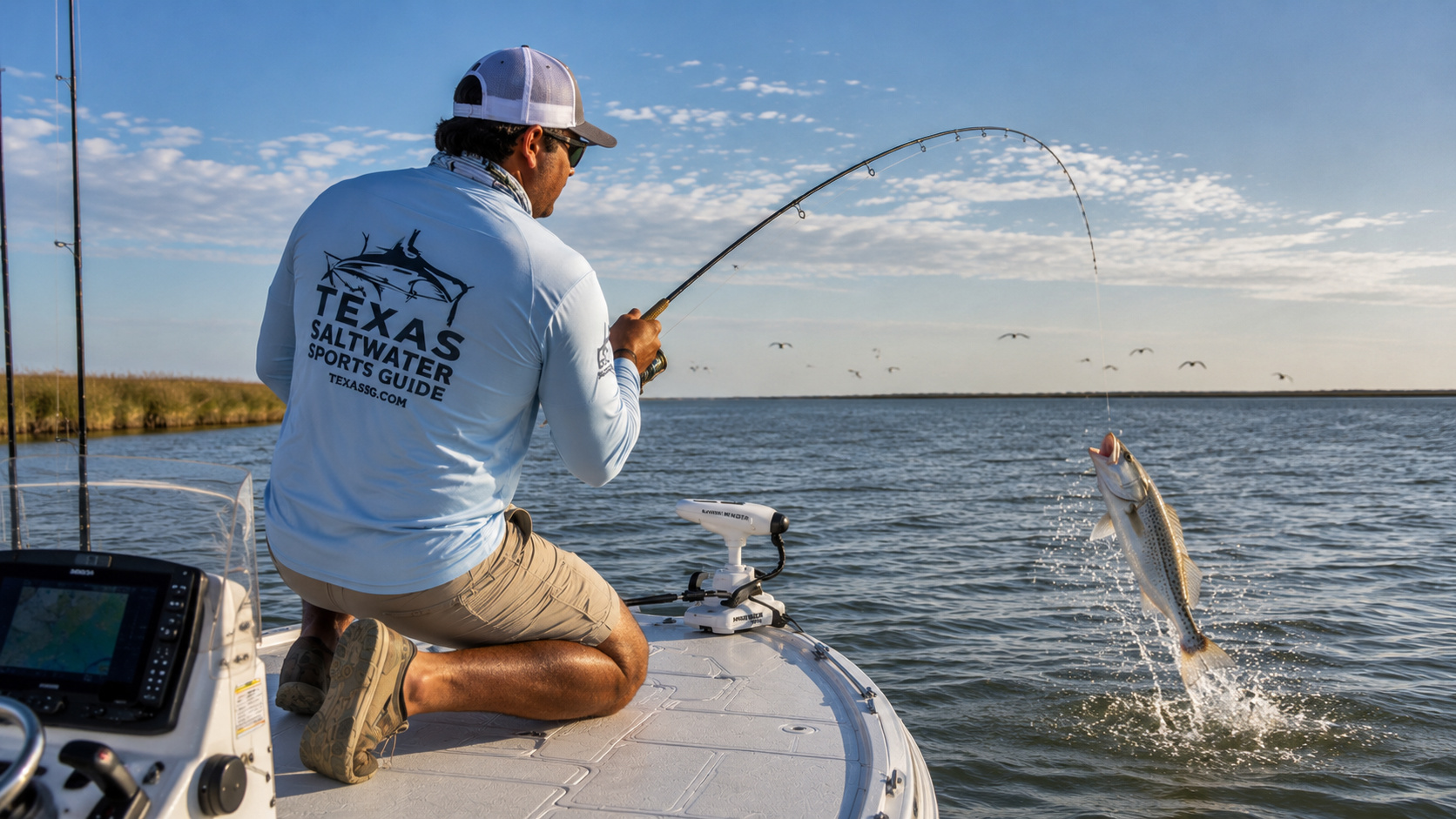
There are mornings on the Texas coast when you know before making the first cast that you've already gotten your money's worth.
The eastern horizon is just beginning to brighten behind Matagorda Island. A few scattered clouds have picked up the first orange light of sunrise. The Yamaha is quiet, the trolling motor is barely turning, and somewhere across Espiritu Santo Bay a gull announces breakfast.
Then you hear it.
Pop.
A trout.
Not the nervous flipping of a mullet or the little splash of a shrimp escaping trouble. This is the unmistakable sound of a speckled trout taking something from the surface.
A second trout strikes fifty yards down the shoreline.
Then another.
Suddenly that peaceful sunrise becomes a fishing trip.
I've always thought speckled trout were among the finest game fish Texas has given us. They aren't built like redfish and they don't fight like them. A redfish seems determined to tow the boat somewhere. A big speckled trout fights with more finesse, shaking her head, changing direction and occasionally coming completely out of the water.
And when a heavy trout swallows a topwater plug at sunrise, there isn't much in fishing I'd trade for the sound.
If you've been wondering How to Catch Speckled Trout in Espiritu Santo Bay Texas, the answer begins with learning the bay itself.
Where Is Espiritu Santo Bay?
Espiritu Santo Bay lies along the middle Texas coast adjacent to Port O'Connor and Matagorda Island. It forms part of the larger San Antonio Bay and Guadalupe Estuary complex, with connections to Matagorda Bay, the Gulf Intracoastal Waterway, Pass Cavallo and numerous marshes and tidal lakes.
The bay is approximately 16 miles long and about five miles wide.
Matagorda Island separates much of Espiritu Santo Bay from the Gulf of Mexico, creating an enormous protected estuarine environment of shallow flats, oyster shell, mud, sand, grass, marshes and channels.
For a trout fisherman, that's a rather impressive tackle box Mother Nature has assembled.
How Deep Is Espiritu Santo Bay?
Much of Espiritu Santo Bay is shallow.
A great deal of productive trout water lies between approximately 2 and 6 feet deep, although channels, passes and the Gulf Intracoastal Waterway provide substantially greater depths.
Don't make the mistake of believing a shallow bay lacks meaningful structure.
A two-foot flat dropping into four feet can be significant.
So can an oyster ridge rising twelve inches above the surrounding bottom.
Trout respond to subtle changes because those changes influence current and concentrate prey.
The important bottom types include:
-
Oyster shell
-
Mud
-
Sand
-
Seagrass
-
Mixed shell and mud
-
Sandy potholes
-
Channel edges
When two different types of bottom meet, pay attention.
Those transitions are natural feeding stations.
Rivers Feeding Espiritu Santo Bay
Espiritu Santo Bay belongs to the larger Guadalupe Estuary.
The Guadalupe River and San Antonio River provide the principal freshwater influence to this interconnected estuarine system.
That freshwater is vital.
It carries nutrients into the estuary and affects salinity, shrimp production and the distribution of baitfish.
After major rainfall, trout may move toward portions of the system offering more favorable salinity. During prolonged dry periods, Gulf salinity pushes farther into the bays.
This is why coastal fishermen should pay attention to rainfall well upstream.
What happened hundreds of miles away several weeks ago can eventually influence where you find trout.
Fish Species in Espiritu Santo Bay
Texas Parks and Wildlife specifically identifies sea trout, redfish, black drum and flounder as predominant species around Matagorda Island. TPWD also confirms fishing opportunities along the shallow Espiritu Santo Bay shoreline and from the island's docks. (Texas Parks & Wildlife Department)
Other fish commonly encountered throughout the surrounding coastal system include:
-
Speckled trout
-
Redfish
-
Southern flounder
-
Black drum
-
Sheepshead
-
Sand trout
-
Croaker
-
Whiting
-
Jack crevalle
-
Gafftop catfish
-
Hardhead catfish
-
Spanish mackerel closer to passes
-
Sharks in Gulf-connected water
Forage is equally important.
Shrimp, mullet, pinfish, croaker, menhaden and other small fish provide the groceries that keep trout growing.
Find the grocery store and sooner or later you'll find the customers.
Port O'Connor: Your Gateway to Espiritu Santo Bay
For visiting fishermen, Port O'Connor is the natural headquarters for an Espiritu Santo Bay trip.
It provides access toward Matagorda Island, Espiritu Santo Bay, Pass Cavallo and the surrounding marsh country.
Port O'Connor remains the sort of Texas coastal community where fishermen don't look out of place at breakfast wearing fishing shirts and smelling faintly of live shrimp.
That's my kind of town.
Bait Camps and Marinas Near Espiritu Santo Bay
The Fishing Center
Address: 1303 Water Street, Port O'Connor, TX 77982
Phone: 361-983-4440
Email: Contact through the official website
Hours currently published: Monday-Saturday 5 a.m.-5 p.m.; Sunday 5 a.m.-4 p.m.
The Fishing Center offers boat ramps, wet slips, fish-cleaning tables, fuel and a bait shop. Current bait listings include live and frozen shrimp, live croaker, mullet and other inshore and offshore bait. (The Fishing Center)
The Fishing Center official website
Froggie's Bait Dock
Address: 2649 Stella Avenue, Port O'Connor, TX 77982
Phone: Current listings conflict between 361-983-4466 and 361-250-9300, so I recommend confirming before your trip.
Email: No dependable public general email found.
Froggie's is a familiar Port O'Connor launching and bait stop. Current listings describe live bait, fuel and multi-lane launching facilities. (Chamber of Commerce)
Because phone information varies among current listings, calling ahead through the latest business listing is wiser than printing one number permanently on the dashboard.
Boat Ramps and Fishing Access
The Fishing Center and Froggie's provide two of the most convenient Port O'Connor launching choices.
TPWD also identifies access associated with the Port O'Connor paddling trail system.
Matagorda Island WMA is another important destination, but there is a crucial distinction: Matagorda Island is accessible by boat only. TPWD says no permit is required for day use of the WMA, and fishing is permitted with a valid Texas fishing license. (Texas Parks & Wildlife Department)
The Espiritu Santo side offers:
-
Dock fishing
-
Shallow-water fishing
-
Wade fishing
That makes Matagorda Island particularly interesting to fishermen who enjoy leaving the boat behind and working a shoreline slowly.
Lodging in Port O'Connor
Redfish Lodge Port O'Connor
Address: 710 W. Madison Avenue, Port O'Connor, TX 77982
Phone: 866-903-7742
Email: redfishlodgepoc@gmail.com
The lodge offers ten suites and caters directly to anglers and other coastal visitors. (Redfish Lodge Poc)
Poco Loco Lodge
Address: 305 W. Adams Avenue, Port O'Connor, TX 77982
Phone: 361-983-0300
Email: team@staypocoloco.com
Port O'Connor Rentals
Address: 36 Cemetery Street, Port O'Connor, TX 77982
Phone: 361-759-4371
Email: info@pocrentals.com
Vacation homes can be particularly convenient for a fishing party because you'll often have more room for coolers, tackle and boat parking.
Driving to Espiritu Santo Bay
Port O'Connor is the most useful destination when calculating road mileage.
Austin
Approximately 175 miles, generally about three hours.
A practical route follows US-183 south toward Victoria, then TX-185 through Seadrift to Port O'Connor.
Corpus Christi
Approximately 90 miles, generally 1½ to 2 hours.
Travel north toward the Port Lavaca/Seadrift area and connect with TX-185.
Houston
Approximately 160 miles, generally about three hours.
I-69/US-59 toward Victoria followed by the coastal highway network and TX-185 is a common route.
San Antonio
Approximately 155 miles, generally around three hours.
US-87 toward Victoria followed by TX-185 works well.
Dallas
Approximately 390 miles, roughly 6½ to 7 hours depending upon traffic.
Fort Worth
Approximately 380 miles, also roughly 6 to 7 hours.
Check current navigation before departure because construction and traffic can change the best route.
How to Catch Speckled Trout in Espiritu Santo Bay Texas by Season
Now we get to the enjoyable part.
Speckled trout live in the system throughout the year, but where and how you catch them changes dramatically with temperature, wind and bait movement.
Spring: Trout Return to Shallow Structure
March through May brings warming water.
Shrimp become more active.
Mullet become increasingly visible.
Trout begin spreading over shell, grass and shoreline structure.
Look for water between 2 and 5 feet around oyster reefs and adjacent flats.
Spring wind is the great complication.
A southeast wind can rough up open water, but don't automatically curse it. Moderate wind can push bait toward a shoreline and create current over shell.
Use it.
Good spring presentations include:
-
3 to 5-inch paddle tails
-
Suspending twitchbaits
-
Live shrimp
-
Popping cork rigs
If the water is clear, lean toward natural colors.
If wind muddies the water, increase contrast.
Summer: Start in the Dark
July fishing teaches a man the value of an alarm clock.
Launch early.
Before sunrise, work shallow flats, shorelines and reefs.
This is prime topwater time.
Listen for trout feeding.
Watch for slicks.
Look for nervous mullet.
As sunlight strengthens, fish generally become less comfortable in skinny water.
Move toward deeper shell and channel edges.
During the heat of summer, water temperature and dissolved oxygen matter. Areas with current can be particularly productive.
Fall: A Fisherman's Favorite
Fall may be the most consistently enjoyable trout season on the middle coast.
Water begins cooling.
Shrimp and baitfish move.
Cold fronts become increasingly important.
Trout feed aggressively before winter.
Work reefs, drains, grass edges and shorelines holding mullet.
Topwaters remain effective on calm mornings, while paddle tails provide dependable action throughout the day.
A cloudy October morning with a light southeast breeze over shell is difficult to improve upon.
Winter: Mud, Shell and Patience
Winter separates fishermen who understand structure from fishermen who understand only spots.
After a strong norther, shallow water can disappear rapidly.
Trout respond by moving toward:
-
Guts
-
Channels
-
Deeper holes
-
Mud adjacent to shell
-
Protected shorelines
Dark mud warms under afternoon sunshine.
That can make an enormous difference.
Instead of fishing at dawn, winter fishermen sometimes benefit from sleeping an extra hour and fishing the afternoon warm-up.
I won't claim that's why winter fishing was invented, but it's a civilized arrangement.
Where to Catch Speckled Trout in Espiritu Santo Bay
Oyster Reefs
Shell is fundamental trout habitat.
Oysters attract small crabs, shrimp and baitfish while creating current breaks.
Don't simply fish the top of every reef.
Fish:
-
Up-current edges
-
Down-current edges
-
Points
-
Gaps
-
Nearby drop-offs
A reef adjacent to deeper water is especially attractive during temperature extremes.
Matagorda Island Shoreline
TPWD specifically identifies sea trout among the predominant species around Matagorda Island and permits shallow-water and wade fishing along its Espiritu Santo Bay side. (Texas Parks & Wildlife Department)
Look for grass, sand pockets, shell and bait movement.
On calm mornings, this can be excellent territory for topwaters.
Grass and Sand Potholes
Grass flats broken by lighter sandy potholes create natural ambush points.
Trout may hold along the edges waiting for shrimp or mullet.
Cast beyond the pothole and work your lure through it.
Marsh Drains
Although we often associate drains with redfish and flounder, trout use them too.
Moving water is the key.
A drain emptying shrimp into slightly deeper bay water deserves several casts.
Channel Edges
During summer heat and winter cold, deeper edges become increasingly important.
Work the contour rather than randomly casting into the middle.
Finding Trout by Finding Bait
This may be the most useful advice in the entire article.
Don't fish beautiful water without life.
Look for:
-
Mullet
-
Shrimp
-
Diving birds
-
Slicks
-
Bait dimpling the surface
Fresh trout slicks can have a distinctive watermelon or cut-grass smell.
A small slick is often more useful than an enormous one because it may have formed recently.
When you find bait over suitable structure, slow down.
For similar middle-coast tactics, our guide to Speckled Trout Fishing in Mesquite Bay covers another shallow estuary where shell, grass and moving water play the same central roles.
Best Tides for Espiritu Santo Bay Trout
Texas middle-coast tides aren't enormous, but that doesn't make them unimportant.
Wind can alter predicted water levels substantially.
Incoming Tide
An incoming tide moves water toward shorelines and shallow structure.
Trout may follow bait toward:
-
Grass
-
Reefs
-
Shoreline points
-
Marsh mouths
Falling Tide
A falling tide pulls forage away from shallow habitat.
Concentrate around:
-
Drains
-
Reef edges
-
Guts
-
Channel intersections
Slack Water
When current stops, feeding may slow.
That's a good time to relocate, eat a sandwich or inspect the bait situation somewhere else.
Best Rod and Reel for Speckled Trout
A trout outfit should be light enough to cast all day and sensitive enough to detect subtle strikes.
Rod
Length: 6'10" to 7'6"
Power: Medium-light to medium
Action: Fast
Reel
A 2500 or 3000-size spinning reel is ideal for most bay fishing.
Line
Use 8 to 15-pound braid.
Leader
A 15 to 20-pound fluorocarbon leader handles most situations.
Around heavy shell, 20 to 25 pounds provides additional abrasion resistance.
Best Speckled Trout Lures
Paddle Tail Soft Plastics
If I could carry only one artificial lure, a paddle tail would make the short list.
Size
3 to 5 inches.
Jigheads
1/16 ounce for shallow flats.
1/8 ounce for general fishing.
3/16 to 1/4 ounce for deeper water or stronger current.
Clear-Water Colors
-
Pearl
-
Natural mullet
-
Opening Night
-
Silver
-
Clear/glitter combinations
Stained-Water Colors
-
Plum/chartreuse
-
Chicken on a Chain
-
Texas Roach
-
Morning Glory
-
Dark body with bright tail
Let the fish decide.
Color arguments have probably consumed more dock time than actual fishing.
Topwater Plugs
Topwater trout fishing is addictive.
Size
4 to 5½ inches.
Colors
-
Bone
-
Chrome
-
Black
-
Natural mullet
Walk the bait rhythmically.
If trout slap at it without taking it, pause.
If they continue missing, follow with a soft plastic.
Suspending Twitchbaits
Cold-water trout fishermen should carry suspending plugs.
Size
3½ to 5 inches.
Retrieve with two or three twitches followed by a pause.
In cold water, make the pause longer than feels reasonable.
Big trout are perfectly capable of studying your lure while you become impatient.
Corky-Style Soft Suspending Baits
These are outstanding over winter mud and shell.
Work them slowly.
The goal isn't to make the lure race across the bay.
The goal is to keep it hanging in the strike zone.
Live Bait for Speckled Trout
Texas fishermen have been catching trout on live bait since long before anybody invented scented plastic.
Good choices include:
-
Live shrimp
-
Croaker
-
Finger mullet
-
Small pinfish
Live shrimp under a popping cork remains one of the best all-around presentations.
Adjust leader length so the shrimp travels just above the grass or shell.
During summer, live croaker can be extremely effective around deeper reefs.
Bay Boat Fishing
A shallow-running 21 to 24-foot bay boat is ideal for Espiritu Santo Bay.
The important features are:
-
Shallow draft
-
Stable casting deck
-
Reliable trolling motor
-
GPS/chartplotter
-
Adequate fuel range
-
Good rough-water manners
Use the outboard to reach the general area.
Then shut it down early.
Approach productive reefs and shorelines on the trolling motor.
Noise matters enormously in shallow water.
A fisherman can't spend ten minutes banging compartment lids and then complain that the trout are spooky.
Wade Fishing Espiritu Santo Bay
Wading is one of the finest ways to fish this bay.
TPWD specifically confirms wade-fishing opportunities on the Espiritu Santo Bay side of Matagorda Island. (Texas Parks & Wildlife Department)
Wading allows you to:
-
Fish quietly
-
Cover structure slowly
-
Keep the boat away from trout
-
Work precise depth changes
Wear proper footwear.
Shuffle your feet for stingrays.
Use a wading belt and know where channels are before stepping into them.
For more techniques applicable to this style of fishing, see our Aransas Bay Speckled Trout Fishing Guide.
Shore and Jetty Fishing
Port O'Connor offers opportunities for fishermen without boats, particularly around public access and the Little Jetties area.
Trout may move within casting range during favorable tides, particularly early and late in the day.
Try:
-
Live shrimp beneath a cork
-
Paddle tails
-
Suspending plugs
-
Small topwaters
Around stronger jetty current, increase jighead weight enough to maintain lure control.
Remember that passes and the Intracoastal can carry significant current and vessel traffic.
Current Texas Speckled Trout Limits
For the 2025-26 license year ending August 31, 2026, TPWD lists:
Daily Bag: 3 spotted seatrout
Minimum Length: 15 inches
Maximum Length: 20 inches
Possession Limit: Twice the daily bag limit
TPWD also provides tagging provisions allowing one trout over 28 inches with a properly completed Spotted Seatrout Tag and another over 28 inches with a Bonus Spotted Seatrout Tag during the license year. (Texas Parks & Wildlife Department)
Because we are approaching the September 1 changeover, check TPWD's 2026-27 Outdoor Annual before fishing after August 31, 2026.
TPWD Spotted Seatrout Regulations
Conservation deserves a word here.
Large female trout are extraordinarily valuable spawning fish. Keeping a legal fish is part of Texas fishing tradition, but releasing a trophy is also a fine way to ensure somebody else, perhaps a grandchild many years from now, gets to feel that same heavy head shake.
Related Texas Saltwater Fishing Guide Articles
Espiritu Santo Bay doesn't exist in isolation. Its fishing patterns share much with neighboring Texas estuaries. When planning a longer coastal trip, these five internal guides provide useful companion reading:
Boating Safety on Espiritu Santo Bay
A calm Texas bay at sunrise can look harmless.
It isn't.
Weather changes quickly.
Shallow reefs damage lower units.
Fog removes landmarks.
Summer thunderstorms produce lightning and violent wind.
Winter northers can drop temperatures and water levels remarkably fast.
Carry:
-
Coast Guard-approved PFDs
-
Engine cutoff switch
-
VHF marine radio
-
Charged waterproof phone
-
GPS/chartplotter
-
Navigation lights
-
First-aid kit
-
Emergency signaling equipment
-
Anchor with adequate rode
-
Drinking water
-
Sun protection
-
Basic tools
The Gulf Intracoastal Waterway deserves special respect.
Commercial barges cannot dodge a fishing boat.
Give them plenty of room.
Their wake may reach you well after they pass.
And never run an unfamiliar shallow flat simply because another boat did.
He may know something you don't.
Or he may be about to learn something expensive.
A Simple Espiritu Santo Bay Trout Plan
Suppose I were launching tomorrow without reliable information from yesterday.
I'd begin before sunrise.
Three rods would be ready.
Rod One: Bone topwater.
Rod Two: 4-inch paddle tail on a 1/8-ounce jighead.
Rod Three: Suspending twitchbait.
I'd start around shallow shell or grass holding mullet.
If trout were feeding on top, I'd stay with the surface plug.
As the sun climbed, I'd work the soft plastic slightly deeper.
If the shallow bite disappeared, I'd move toward deeper shell and channel edges rather than simply racing farther down the shoreline.
On an incoming tide, I'd follow water toward shallow structure.
On a falling tide, I'd concentrate on drains, reef edges and guts.
And above everything else, I'd look for bait.
That's the plan.
The trout, naturally, haven't agreed to it.
That's fishing.
Final Thoughts on How to Catch Speckled Trout in Espiritu Santo Bay Texas
There is a photograph that exists in the memory of almost every longtime Texas coastal fisherman.
It isn't necessarily a photograph anyone ever took.
The boat is floating quietly somewhere before sunrise.
Maybe it's October.
The air carries just enough chill to make a light jacket comfortable.
Matagorda Island is little more than a dark line against the eastern horizon.
A few gulls are beginning to move.
Mullet flick occasionally beside the boat.
Then the sky changes.
Gray becomes lavender.
Lavender becomes orange.
The first sunlight touches the water.
You make a long cast across a shallow reef.
The topwater lands with a soft plop.
You twitch it once.
Twice.
Nothing.
Three more turns of the reel.
Then the water beneath the lure simply disappears.
A heavy trout rolls across the surface.
The rod loads.
For the next several seconds, you're not thinking about tomorrow.
You're certainly not thinking about yesterday.
You're not thinking about how much fuel costs or what time you need to get home.
You're standing on the Texas coast with a bent fishing rod in your hands and a big speckled trout shaking her head beneath a sunrise.
That's enough.
Perhaps that's why we keep going back.
Learning How to Catch Speckled Trout in Espiritu Santo Bay Texas requires understanding reefs, tides, bait, seasons, weather and presentation. Those things matter.
But the older a fisherman gets, the more he realizes there is another part of the equation.
You have to be there.
You have to get up while it's dark.
You have to launch the boat.
You have to leave the outboard behind and drift quietly onto the flat.
And you have to make that first cast without knowing exactly what will happen.
Sometimes nothing does.
Sometimes a gull flies past and the sun rises and you simply spend a beautiful morning on Espiritu Santo Bay.
Other mornings, the line comes tight.
And after all these years, that possibility is still more than enough reason to go fishing.
0 Comments