
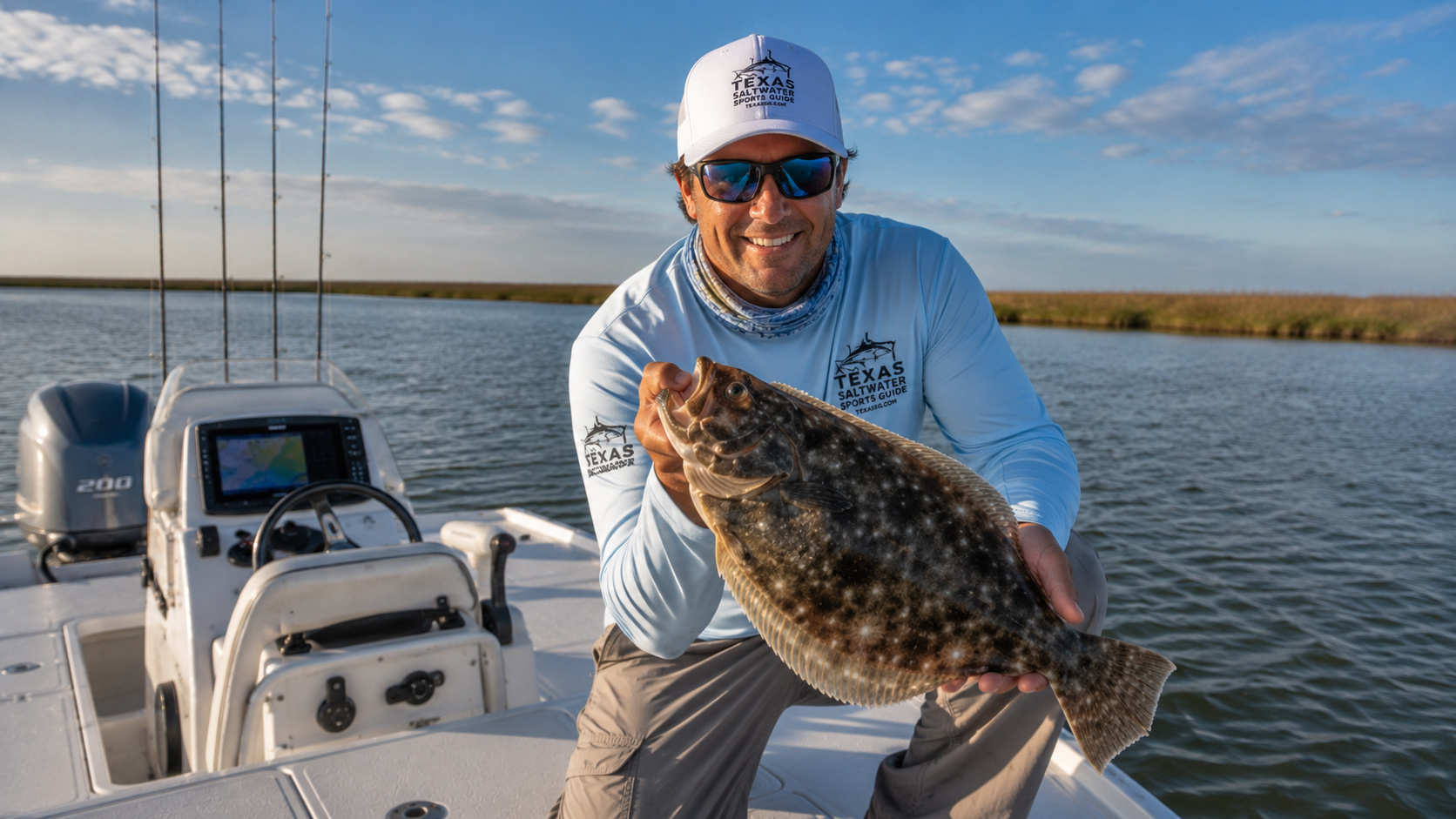
There is something almost unfair about a flounder.
A redfish announces himself with a wake. A speckled trout may give away her position by knocking a shrimp clear out of the water. Jack crevalle occasionally behave as though somebody fired a cannon into the bay.
A flounder?
He lies on the bottom looking like part of it.
Both eyes stare upward. His mottled skin blends into sand, shell and mud. He may remain almost motionless while a shrimp or finger mullet approaches, and then, in an instant, the bottom comes alive.
That's one reason I've always enjoyed flounder fishing. It rewards a fisherman who is willing to slow down.
And Espiritu Santo Bay is made for that kind of fishing.
Between Port O'Connor and Matagorda Island lies a wonderful collection of shallow shorelines, tidal drains, shell, marshes, guts and deeper channels. Texas Parks and Wildlife specifically identifies flounder as one of the predominant fish species around Matagorda Island and permits shallow-water, bank and wade fishing along its Espiritu Santo Bay side. (Texas Parks & Wildlife Department)
If you're searching for How to Catch Flounder in Espiritu Santo Bay Texas, pull up a chair. This is one fish where patience isn't merely a virtue.
It's part of the tackle.
Where Is Espiritu Santo Bay Texas?
Espiritu Santo Bay lies along the middle Texas coast in Calhoun County, adjacent to Port O'Connor and behind Matagorda Island.
It connects with the greater San Antonio Bay and Matagorda Bay systems, the Gulf Intracoastal Waterway, Pass Cavallo and a maze of marshes, lakes and tidal channels.
The bay is approximately 16 miles long and roughly five miles wide.
Those numbers tell only part of the story because an estuary isn't a swimming pool with fixed edges. Water levels rise and fall with tides, wind and weather, periodically flooding broad expanses of marsh and then draining them again.
That movement is tremendously important to flounder.
A flounder fisherman should think less about square miles and more about funnels.
Where does water enter?
Where does it leave?
Where must shrimp and finger mullet pass when a flat drains?
Answer those questions and you're beginning to think like a flounder fisherman.
How Deep Is Espiritu Santo Bay?
Much of the fishable bay is shallow, commonly around 1 to 6 feet, while navigation channels, passes and the Gulf Intracoastal Waterway provide considerably deeper water.
Flounder don't necessarily require deep water.
What they love is change.
A flat dropping from two feet to four feet can be valuable.
A shallow drain intersecting a six-foot channel can be better still.
Look for transitions involving:
-
Sand and mud
-
Mud and shell
-
Grass and sand
-
Oyster edges
-
Channel drop-offs
-
Marsh drains
-
Shoreline points
-
Sandy potholes
A flounder doesn't need much structure. He simply needs a place where structure gives him an advantage over dinner.
What Rivers Feed Espiritu Santo Bay?
Espiritu Santo Bay is part of the larger Guadalupe Estuary system.
Its principal freshwater influence ultimately comes from the Guadalupe and San Antonio rivers, entering through the interconnected San Antonio Bay system.
Freshwater inflow carries nutrients and changes salinity. Those changes influence shrimp, crabs, mullet, mud minnows and other forage.
And wherever the groceries go, predators eventually follow.
Heavy rainfall can alter salinity and fish distribution considerably. During prolonged dry weather, saltier Gulf water may penetrate farther into the estuary.
For that reason, experienced coastal fishermen watch rainfall as well as tide charts.
Yesterday's thunderstorm fifty miles inland may eventually become next month's fishing pattern.
Fish Species in Espiritu Santo Bay
Texas Parks and Wildlife identifies flounder, redfish, sea trout and black drum as predominant species around Matagorda Island. (Texas Parks & Wildlife Department)
Throughout the surrounding estuary, fishermen may encounter:
-
Southern flounder
-
Speckled trout
-
Redfish
-
Black drum
-
Sheepshead
-
Sand trout
-
Croaker
-
Whiting
-
Jack crevalle
-
Gafftop catfish
-
Hardhead catfish
-
Spanish mackerel nearer Gulf passes
-
Sharks in warmer Gulf-connected water
For flounder fishermen, the more interesting list may be what's on the menu:
-
Brown and white shrimp
-
Mud minnows
-
Finger mullet
-
Small croaker
-
Menhaden
-
Pinfish
-
Small crabs
Find those forage species around suitable bottom structure and you've found water worth fishing.
Port O'Connor: Gateway to Espiritu Santo Bay
For most visiting anglers, Port O'Connor is the practical headquarters for an Espiritu Santo Bay trip.
Port O'Connor gives fishermen access toward Espiritu Santo Bay, Matagorda Island, Pass Cavallo and the surrounding marsh country.
And it's still a fishing town.
Before daylight you'll find boats at the ramps, fishermen buying bait and somebody holding a cup of coffee strong enough to remove paint from an outboard.
That's usually a good sign.
Bait Camps, Marinas and Boat Ramps
The Fishing Center
Address: 1303 Water Street, Port O'Connor, TX 77982
Phone: 361-983-4440
Email: Use the current contact form/direct contact through the official website
Services: Bait, ramps, wet slips, provisions, RV facilities and boating services
The Fishing Center currently lists hours beginning at 5 a.m., making it particularly convenient for fishermen planning a daylight launch. (The Fishing Center)
The Fishing Center official website
For flounder, ask about the day's supply of live shrimp and small baitfish rather than assuming a particular bait will be available.
Froggie's Bait Dock
Address: 2649 Stella Avenue, Port O'Connor, TX 77982
Phone: Confirm the current number before traveling
Email: No reliably published general email located
Services: Bait, launching and fishing provisions
Because online telephone listings for Froggie's have not been consistent, I would rather tell you to verify the number than give you one confidently and send you into the electronic wilderness.
Matagorda Island WMA
Location: Offshore from Port O'Connor
TPWD Phone: 361-205-1510
Access: Boat only
TPWD says no permit is required for day use, although anglers need a valid Texas fishing license. Fishing opportunities include docks, shallow water and wading on the Espiritu Santo Bay side. (Texas Parks & Wildlife Department)
TPWD Matagorda Island WMA fishing information
This is particularly attractive flounder country because shorelines, cuts and shallow-to-deep transitions can be worked methodically rather than simply passed at 30 miles per hour.
Lodging Near Espiritu Santo Bay
Redfish Lodge Port O'Connor
Address: 710 W. Madison Avenue, Port O'Connor, TX 77982
Phone: 866-903-7742
Email: redfishlodgepoc@gmail.com
The lodge caters directly to anglers and has room for trucks and trailers. (Redfish Lodge Poc)
Poco Loco Lodge
Address: 305 W. Adams Avenue, Port O'Connor, TX 77982
Phone: 361-983-0300
Email: team@staypocoloco.com
Poco Loco is an eight-room boutique lodge oriented in part toward fishing and hunting visitors. (Poco Loco Lodge)
For any small coastal business, confirm hours, availability and contact information before leaving home. Storms, ownership changes and seasonal schedules have a way of making old internet listings age faster than bait left in the Texas sun.
Driving Distance to Port O'Connor and Espiritu Santo Bay
Port O'Connor is the most useful destination for planning a road trip.
Austin
Approximately 170 to 180 miles, usually around three hours.
A practical route follows US-183 south toward Victoria and then TX-185 through Seadrift to Port O'Connor.
Corpus Christi
Approximately 90 miles, generally 1½ to 2 hours.
Travel north toward the Port Lavaca/Seadrift area and connect with TX-185.
Houston
Approximately 150 to 165 miles, generally about three hours.
I-69/US-59 toward Victoria followed by the coastal highway network and TX-185 is a common approach.
San Antonio
Approximately 150 to 165 miles, generally about three hours.
US-87 toward Victoria and then TX-185 provides a practical route.
Dallas
Approximately 380 to 400 miles.
Allow roughly 6½ to 7 hours depending upon traffic.
Fort Worth
Approximately 370 to 390 miles.
Allow roughly six to seven hours.
These are planning estimates rather than driveway-to-ramp measurements. Check current navigation and construction conditions before departure.
Espiritu Santo Bay Weather
The middle Texas coast offers year-round fishing, but it certainly doesn't offer the same weather year-round.
Spring
Expect warming conditions, increasing humidity and frequent southeast winds.
Typical daytime temperatures range from the upper 60s into the 80s as spring progresses.
Summer
Summer is hot, humid and bright.
Temperatures routinely reach the upper 80s and 90s.
Early mornings are generally more comfortable for both fishermen and fish.
Afternoon thunderstorms can develop quickly.
Fall
Fall is prime coastal weather.
September remains warm, while October and November bring progressively cooler mornings and the first meaningful northers.
This is also the season most associated with flounder migration.
Winter
Winter temperatures can range from wonderfully mild to surprisingly cold.
Strong northers may arrive quickly, dropping temperatures and pushing water from shallow bays.
Wind often matters more than the thermometer.
A 55-degree calm afternoon can be delightful.
A 55-degree morning with 25 knots of north wind can convince you that somebody moved Port O'Connor to Montana overnight.
Understanding the Southern Flounder
Southern flounder are ambush predators.
Their flattened body allows them to lie nearly invisible against the bottom, with both eyes oriented upward.
Instead of chasing prey over long distances, they commonly position where current carries food past them.
That's why the most productive flounder spots often look unremarkable above water.
A tiny point.
A drain.
A sandy depression.
A channel bend.
An oyster edge.
The fisherman sees nothing.
The flounder sees a dining room.
Where to Catch Flounder in Espiritu Santo Bay Texas
Marsh Drains
If I were allowed only one type of structure, I'd choose a productive marsh drain on falling water.
As water leaves flooded marsh habitat, it carries:
-
Shrimp
-
Mud minnows
-
Finger mullet
-
Small crabs
-
Juvenile baitfish
Flounder position beside the current rather than necessarily in its strongest center.
Work both sides.
Cast beyond the mouth and bring the lure across the transition.
Channel Intersections
Where a small gut joins a larger channel, flounder can position on the bottom and intercept prey.
These areas become increasingly important as water temperatures fall and fish begin moving toward deeper routes.
Matagorda Island Shoreline
The Espiritu Santo Bay side of Matagorda Island provides bank, shallow-water and wade-fishing opportunities, and TPWD specifically lists flounder among its predominant fish species. (Texas Parks & Wildlife Department)
Look for:
-
Small drains
-
Sandy pockets
-
Shell
-
Points
-
Depth changes
-
Bait activity
Don't simply walk miles of shoreline.
Slow down when you find a reason for fish to stop.
Oyster Reef Edges
Flounder frequently use the boundary where oyster shell gives way to sand or mud.
The shell itself attracts forage.
The transition provides concealment.
Current makes the whole arrangement work.
Sandy Potholes
A light-colored sandy depression surrounded by darker bottom deserves attention.
Flounder can settle along the edge and ambush bait crossing the opening.
Fan-cast the entire pothole before moving.
Pass Cavallo
As fall progresses, Gulf-connected passes become increasingly important to migrating flounder.
Current can be considerably stronger here, so heavier jigheads and sinkers may be necessary.
Passes also demand greater boating and wading caution.
Spring Flounder Fishing
Spring is a transition season.
As coastal water warms, flounder that spent colder periods nearer deeper Gulf-connected water begin redistributing through bays and estuaries.
Look for them around:
-
Channel edges
-
Drains
-
Mud-to-sand transitions
-
Protected shorelines
Water between roughly 2 and 6 feet is an excellent starting point.
A 3-inch paddle tail or scented swimming bait on a 1/8-ounce jighead is hard to beat.
Good colors include:
-
New Penny
-
Pearl
-
Natural shrimp
-
Root beer/chartreuse
Work the lure slowly enough to remain near bottom.
Summer Flounder Fishing
Summer flounder spread through productive bay habitat.
Start early.
Fish:
-
Marsh drains
-
Shoreline points
-
Oyster transitions
-
Grass edges
-
Channel margins
During very warm conditions, current and slightly deeper water become increasingly valuable.
Live finger mullet and mud minnows can be excellent.
A simple Carolina rig with enough weight to maintain bottom contact is difficult to improve upon.
Summer also requires common sense from the fisherman.
Carry water.
Wear sun protection.
A wide-brimmed hat is cheaper than a dermatologist.
Fall: The Famous Texas Flounder Migration
This is the season that built the flounder's Texas reputation.
As autumn water temperatures fall, adult southern flounder begin migrating from bays toward Gulf passes for offshore spawning.
Espiritu Santo Bay's relationship with Pass Cavallo makes this seasonal movement particularly interesting.
Look toward:
-
Major drains
-
Channel intersections
-
Deeper guts
-
Pass approaches
-
Points bordering migration routes
September and October can produce excellent fishing as movement builds.
But November brings an important conservation rule.
More on that shortly.
The key in fall is to think of flounder as travelers.
Instead of asking only, "Where do they feed?"
Ask:
"Where must they pass to get from here to the Gulf?"
That question can transform a map.
Winter Flounder Fishing
After the primary migration, flounder numbers inside the bay may be lower, but winter fishing shouldn't be dismissed.
Concentrate on:
-
Deeper channels
-
Protected mud bottoms
-
Gulf-connected water
-
Warm afternoon shallows adjacent to depth
Slow the presentation dramatically.
Cold fish generally don't need a lure moving like it's late for an appointment.
Best Tides for Espiritu Santo Bay Flounder
Moving water matters more than whether the tide chart has a pretty number printed beside it.
Falling Tide
This is my favorite.
Water draining from marshes funnels prey toward predictable locations.
Fish the mouths of drains, guts and creeks.
Position your boat so the lure moves naturally with or across the current.
Incoming Tide
Incoming water floods shorelines and allows forage to move shallow.
Flounder may follow.
Fish shoreline points, flooded grass edges and sand pockets.
Slack Tide
Fishing often slows when water movement stops.
That's an excellent opportunity to relocate, retie leaders, eat lunch or tell your fishing partner that the fish were definitely biting yesterday.
Wind Is a Tide of Its Own
This deserves its own section because wind moves enormous amounts of water in shallow Texas bays.
A sustained southeast wind can push water onto flats.
A strong norther can pull it away.
That means the predicted tide may say one thing while the shoreline says something entirely different.
Trust the shoreline.
If a north wind has emptied a flat, don't keep casting where the fish were yesterday.
Follow the water toward drains and deeper guts.
Best Depth for Flounder
A useful general guide is:
Shallow shorelines: 1 to 3 feet
Marsh drains: 2 to 5 feet
Oyster transitions: 2 to 6 feet
Channel edges: 4 to 10 feet
Fall migration routes and passes: variable and often considerably deeper
Don't become married to a depth number.
The transition is usually more important than the number itself.
Best Rods and Reels for Flounder
Flounder don't require enormous tackle.
Sensitivity matters more.
Rod
A 6'10" to 7'3" medium-light or medium-power fast-action spinning rod is ideal.
You want enough sensitivity to distinguish a flounder bite from bottom.
Reel
A 2500 to 3000-size spinning reel provides plenty of capacity and drag.
Main Line
Use 10 to 15-pound braided line.
Braid transmits subtle bottom contact beautifully.
Leader
Use 15 to 25-pound fluorocarbon.
Move toward the heavier end around oysters.
Best Artificial Lures for Espiritu Santo Bay Flounder
Paddle Tails
Size: 3 to 4 inches
Good colors:
-
Pearl
-
New Penny
-
Opening Night
-
Root beer/chartreuse
-
Chicken on a Chain
Use 1/8 to 1/4-ounce jigheads depending upon depth and current.
Scented Swimming Baits
A 3 or 4-inch scented swimming mullet or grub is excellent because it combines movement with scent.
Colors:
-
White
-
Chartreuse
-
New Penny
-
Natural
Soft Plastic Shrimp
Three to four inches is about right.
Fish it on a jighead or Carolina rig.
Curly-Tail Grubs
Never dismiss an old lure merely because tackle companies invented newer packaging.
A curly-tail grub hopped slowly across bottom has been catching flounder for generations.
How to Retrieve a Flounder Lure
Slowly.
Then slow down a little more.
A productive retrieve might be:
Lift.
Drop.
Pause.
Drag.
Pause.
Most of the action should occur near bottom.
When a flounder takes a lure, the sensation may be nothing more dramatic than extra weight.
Sometimes it feels as though your lure snagged a wet dishrag.
Don't immediately swing hard at every bit of resistance.
With artificial lures, maintain tension and make a firm hookset once you're confident the weight is alive. With natural bait, a brief delay can allow a flounder that grabbed the bait crosswise to reposition it, but excessively long waits increase the chance of deep hooking.
Best Live Bait
Excellent flounder baits include:
-
Finger mullet
-
Mud minnows
-
Live shrimp
-
Small pinfish where legal and appropriate
-
Fresh dead shrimp
A Carolina-rigged mud minnow dragged slowly beside a drain is about as traditional as Texas flounder fishing gets.
Bay Boat Fishing for Flounder
A 21 to 24-foot shallow-running bay boat is extremely useful.
Use the outboard to reach the general fishing area, then shut it down.
Lower the trolling motor and work slowly.
Flounder fishing isn't normally about covering ten miles of shoreline.
It's about thoroughly covering ten yards of the right shoreline.
Use your GPS/chartplotter to identify:
-
Channel intersections
-
Contour changes
-
Pass approaches
-
Drains
And keep an eye on the actual water.
A map won't show today's shrimp jumping beside a marsh point.
Wade and Shore Fishing
TPWD confirms bank, shallow-water and wade-fishing opportunities on the Espiritu Santo Bay side of Matagorda Island. (Texas Parks & Wildlife Department)
Wading is wonderfully suited to flounder because it forces a fisherman to slow down.
Fan-cast.
Take a few steps.
Fan-cast again.
Wear protective footwear and shuffle your feet to reduce the chance of stepping directly onto a stingray.
The Little Jetties and other Port O'Connor public-access areas can provide additional opportunities, particularly where tidal current creates ambush points.
Jetty and Pass Fishing for Flounder
Gulf passes become particularly important during seasonal migration.
Fish bottom structure along current edges.
You'll generally need more weight than inside the bay.
Keep the bait near bottom without allowing it to tumble uncontrollably.
Be particularly careful around:
-
Strong current
-
Slippery rocks
-
Vessel wakes
-
Sudden depth changes
Never wade an unfamiliar pass casually.
The flounder isn't worth becoming part of the structure.
Current Texas Flounder Regulations
This section deserves careful attention.
For the 2025-26 license year, valid through August 31, 2026, TPWD lists:
Daily Bag Limit: 5 flounder
Minimum Length: 15 inches
Maximum Length: None
Possession Limit: Equal to the daily bag
Most importantly, Texas closes the recreational flounder fishery from November 1 through December 14, when the bag limit becomes zero. (Texas Parks & Wildlife Department)
TPWD Flounder Bag and Length Limits
Because today is August 11, 2026, those published regulations are nearing the end of their stated validity period.
Check the new 2026-27 TPWD Outdoor Annual before fishing on or after September 1, 2026.
That isn't fine print.
It's part of responsible fishing.
Why Texas Protects the Fall Migration
Southern flounder populations have faced significant conservation challenges.
The fall closure protects fish during a critical portion of their migration toward Gulf spawning grounds.
For those of us who grew up when keeping a limit was often the unquestioned measure of success, conservation requires occasionally adjusting old habits.
That's all right.
Tradition isn't diminished by making sure there's something left for the next generation.
A grandchild ought to have the chance to feel that strange heavy thump on the end of a line too.
Five Related Texas Saltwater Fishing Guide Articles
The requested sitemap contains several excellent companion articles, and these five fit naturally with an Espiritu Santo Bay flounder trip:
For another nearby middle-coast flatfish fishery, read our Flounder Fishing in Mesquite Bay guide.
The How to Catch Flounder in Saint Charles Bay Texas article explores similar marsh-drain, shell and channel patterns.
Our Where and How to Catch Flounder in Copano Bay guide offers another useful comparison for fishing mud, sand and tidal structure.
For a broader neighboring bay perspective, see the Aransas Bay Texas Saltwater Fishing Guide.
And the Mesquite Bay Texas Saltwater Fishing Guide provides additional middle-coast information on tides, marshes and seasonal fish movement.
Those links are all from the Texas Saltwater Fishing Guide site and were verified against its current sitemap/search results. (Texas Saltwater Fishing Guide)
Boating Safety on Espiritu Santo Bay
Espiritu Santo Bay deserves respect.
Shallow water can make a large bay look harmless.
It isn't.
Before leaving the dock, check:
-
Marine weather
-
Wind forecast
-
Tide information
-
Radar
-
Fuel
-
Navigation lights
Carry:
-
Properly fitted PFDs
-
Engine cutoff switch
-
VHF marine radio
-
Charged phone in waterproof protection
-
GPS/chartplotter
-
First-aid kit
-
Emergency signaling equipment
-
Anchor and adequate rode
-
Drinking water
-
Sun protection
-
Basic tools
Watch for oyster reefs.
Give commercial vessels in the Intracoastal enormous room.
A loaded tow and barge can't maneuver around a fisherman who decides his flounder spot is worth defending.
It isn't.
Winter northers deserve particular attention. A front can produce strong winds, falling temperatures and rapidly declining water levels.
Summer thunderstorms bring a different danger: lightning.
When the sky starts building vertically and thunder begins muttering in the distance, that's not Mother Nature asking whether you'd like one more cast.
A Simple Espiritu Santo Bay Flounder Game Plan
If I were launching tomorrow morning without yesterday's fishing report, I'd keep things uncomplicated.
I'd have three rods rigged.
Rod One: 3-inch New Penny paddle tail on a 1/8-ounce jighead.
Rod Two: Pearl or chartreuse scented swimming bait on a 1/4-ounce jighead.
Rod Three: Carolina-rigged live finger mullet or mud minnow.
On falling water, I'd begin with marsh drains.
I'd cast beyond the mouth and work the bait slowly across both edges.
If nothing happened, I'd move toward a channel intersection or shell-to-mud transition.
On incoming water, I'd investigate shallow shoreline points and flooded edges.
If I caught one flounder, I wouldn't immediately leave.
That's important.
A productive patch of bottom may hold several fish.
Work it again from a different angle.
Then again.
Flounder fishing rewards stubbornness when the stubbornness is applied to good structure.
Final Thoughts on How to Catch Flounder in Espiritu Santo Bay Texas
There is a different rhythm to flounder fishing.
It isn't the run-and-gun excitement of chasing schooling redfish.
It isn't a speckled trout smashing a topwater plug beneath diving gulls.
Flounder fishing asks you to pay attention to little things.
A drain no wider than a pickup truck.
A patch of sand beside shell.
Six inches of additional depth.
The faint movement of shrimp leaving a marsh.
A little pressure on the rod that wasn't there a moment ago.
Maybe that's why I've always thought flounder fishing suited older fishermen particularly well.
Age eventually teaches most of us that faster isn't necessarily better.
There was a time when I'd measure a fishing day by how much water I covered.
These days, I'm increasingly impressed by how much you can discover by slowing down.
Imagine an October morning on Espiritu Santo Bay.
Sunrise is beginning to illuminate Matagorda Island.
A little fog hangs above the water.
The Yamaha has been shut down for twenty minutes, and the only sound is the trolling motor turning occasionally beneath the bow.
You're working the mouth of a small marsh drain.
Cast.
Let the lure settle.
Lift.
Pause.
Nothing.
Another cast.
Lift.
Pause.
This time the line feels different.
Not a strike exactly.
Just weight.
You tighten the line.
The weight moves.
The rod bends and suddenly the quiet bottom beside the boat erupts as a broad flounder shakes violently beneath the surface.
For a few seconds, everyone aboard becomes considerably younger.
That's one of the things fishing does for us.
Learning How to Catch Flounder in Espiritu Santo Bay Texas comes down to understanding moving water, bottom structure and seasonal movement. Fish marsh drains, channel intersections, sandy potholes, shell edges and migration routes. Keep your presentation near bottom. Adjust to wind and tide. And during autumn, remember that the route toward Pass Cavallo can become every bit as important as the feeding flat you fished during summer.
But don't hurry through it.
Watch the birds.
Notice the marsh.
Listen to the water sliding through the grass.
Enjoy the sunrise.
Because years from now you may remember the flounder.
But there's a pretty good chance you'll remember the morning even more.
0 Comments