
There comes a point in a fisherman's life when he realizes that catching fish was never the whole reason he went fishing.
The realization may arrive quietly.
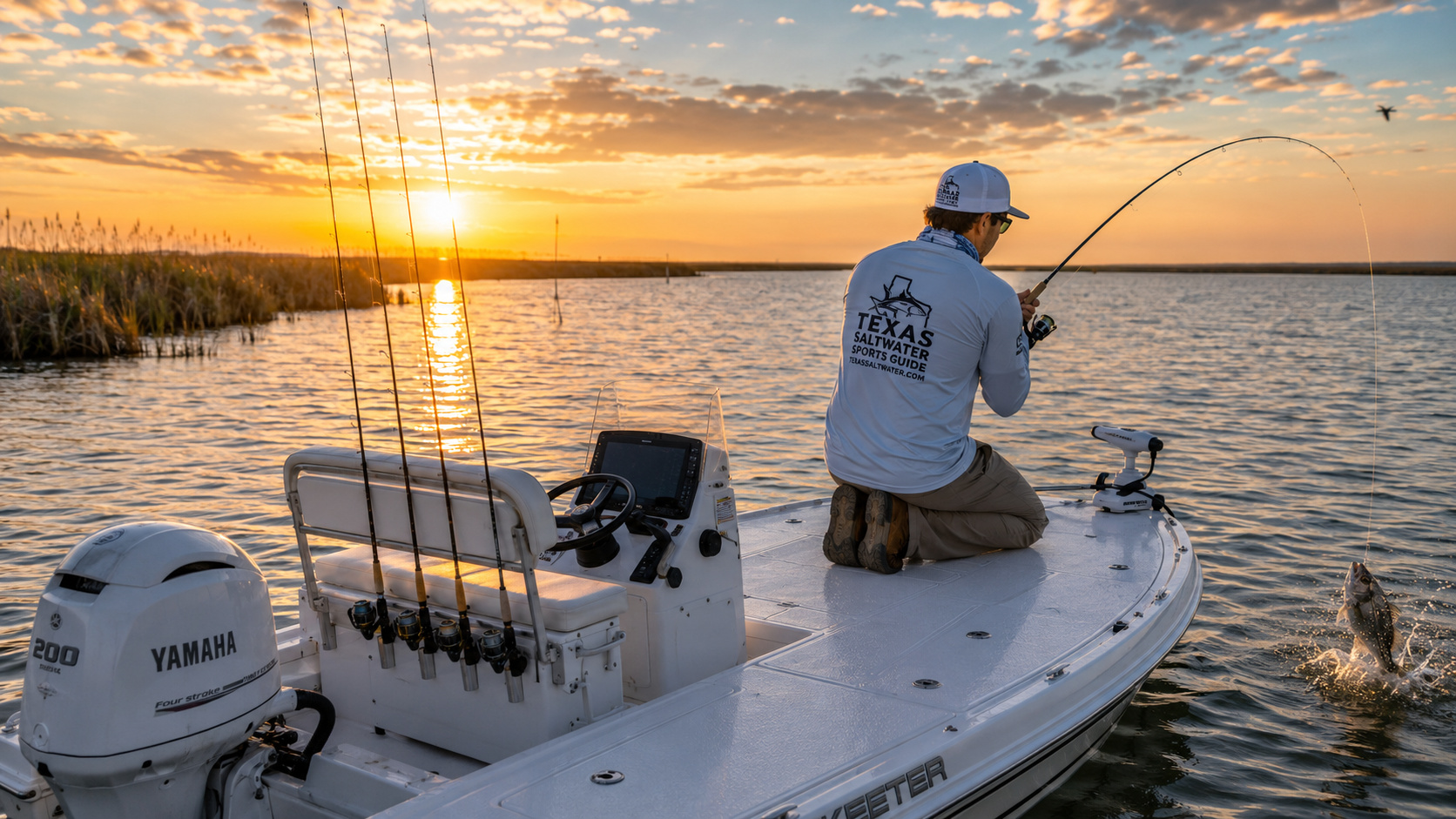
Perhaps you're sitting on the front deck of a bay boat before sunrise with a cup of coffee in your hand. The outboard is silent. A light southeast breeze is carrying the smell of saltwater and marsh grass across the bay. Somewhere beyond the mist a gull cries, a mullet flips, and the eastern horizon begins turning from charcoal gray to orange.
For a few minutes, nobody needs anything from you.
No telephone is ringing.
No television is arguing.
No clock is telling you where you ought to be.
There is simply water, sky, marsh, birds and the wonderful possibility that somewhere beneath that surface a big speckled trout, redfish or flounder is waiting for breakfast.
That is part of the magic of Espiritu Santo Bay Texas Saltwater Fishing.
Located along the middle Texas coast near Port O'Connor, Espiritu Santo Bay is one of those places where excellent fishing and remarkably wild coastal scenery still share the same water. It is a bay made for fishermen who enjoy exploring shorelines, drifting shell, easing across shallow flats and occasionally shutting everything down just to listen.
And these days, I think that last part is every bit as important as the fishing.
Where Is Espiritu Santo Bay Texas?
Espiritu Santo Bay lies in southern Calhoun County between San Antonio Bay and Matagorda Bay, with Matagorda Island separating much of the system from the open Gulf of Mexico.
The bay is approximately 16 miles long and five miles wide. Its shorelines include low coastal ridges, swales, grasslands and scattered oaks, while the underwater landscape includes oyster reefs, tidal flats and bottoms composed of mud, sand and shell.
It is part of the greater San Antonio Bay or Guadalupe Estuary system.
Rather than thinking of Espiritu Santo Bay as an isolated bowl of water, it helps to picture it as one room in a very large coastal house. Water, fish and forage move between Espiritu Santo Bay, San Antonio Bay, Matagorda Bay, the Gulf Intracoastal Waterway, Pass Cavallo and surrounding marshes.
That connectivity is one reason the fishing can be so productive.
The entire San Antonio Bay estuarine system is shallow, averaging roughly three to six feet across much of its area, although channels and passes are considerably deeper.
For anglers, shallow water means structure matters.
A change in depth of only a foot can be important. So can a narrow drain, oyster ridge, grass edge or sandy pothole.
What Rivers Feed Espiritu Santo Bay?
Espiritu Santo Bay is part of the Guadalupe Estuary, whose primary freshwater sources are the Guadalupe and San Antonio rivers.
The Guadalupe provides the majority of freshwater entering the larger system, with the San Antonio River contributing another substantial portion.
That freshwater eventually mixes with more saline water entering from the Gulf side of the system, producing the brackish estuarine environment upon which shrimp, crabs, juvenile baitfish and game fish depend.
After prolonged rainfall, freshwater inflow can lower salinity and push fish toward saltier portions of the system. During dry periods, higher salinity may penetrate farther inland.
That constantly changing mixture is one reason coastal fishing never becomes entirely predictable.
You can learn a bay for forty years and it will still find a way to humble you on Tuesday morning.
Fish Species in Espiritu Santo Bay
The principal game fish include:
-
Speckled trout
-
Redfish
-
Southern flounder
-
Black drum
-
Sheepshead
-
Sand trout
-
Jack crevalle
-
Spanish mackerel near passes
-
Croaker
-
Whiting
-
Gafftop catfish
-
Sharks in warmer months
Texas Parks and Wildlife specifically identifies redfish, sea trout, black drum and flounder among the predominant species around Matagorda Island, including fishing opportunities along the Espiritu Santo Bay shoreline.
For anglers interested in exploring another wonderfully wild middle-coast estuary, our Mesquite Bay Texas Saltwater Fishing Guide covers similar shallow-water habitat just southwest of this system.
The Health Benefits of a Day on Espiritu Santo Bay
We fishermen have always known something that modern research has increasingly put into scientific language.
Being outdoors is good for us.
Fishing combines several beneficial activities almost without our noticing.
You're exposed to natural light. You're moving. You're using your hands. You're balancing on a boat or walking a shoreline. You're watching birds and water instead of screens. You're concentrating on subtle changes in wind, current and bait movement.
Most importantly, your mind gets a chance to become quiet.
Fishing Can Reduce Everyday Stress
There is a particular kind of concentration involved in fishing.
Watch a popping cork drift beside an oyster reef and everything else temporarily disappears.
Work problems disappear.
Bills disappear.
The evening news disappears.
Your entire universe becomes a cork, a tide line and whatever might be swimming underneath it.
That mental narrowing can be wonderfully restorative.
Fishing Keeps the Body Moving
A day on the bay can involve considerably more physical activity than people realize.
Launching a boat, casting, operating a trolling motor, tying knots, netting fish, wading and simply maintaining balance aboard a moving boat all require movement.
Wade fishing adds walking resistance from the water itself.
Kayak fishing provides an even greater cardiovascular workout.
Nobody needs to turn a fishing trip into boot camp. The beauty is that physical activity occurs naturally while doing something enjoyable.
Natural Light and Fresh Air Matter
Early morning sunlight helps regulate the body's circadian rhythm, while time away from indoor environments encourages movement and engagement with the natural world.
Of course, Texas sunshine deserves respect.
Wear a broad-brimmed hat, UV-protective clothing and sunscreen, and drink plenty of water.
A fisherman who becomes dehydrated isn't improving his health. He's simply becoming a raisin with a fishing license.
Fishing Keeps the Mind Working
Finding fish is an ongoing puzzle.
Where is the bait?
Which direction is the current moving?
Has the tide changed?
Is the water clearer on the protected shoreline?
Should I throw bone, chartreuse, plum or natural?
That constant observation and problem solving keeps the mind engaged.
And perhaps most importantly, fishing creates memories with spouses, children, grandchildren and old friends.
Long after you've forgotten how many trout were in the box, you'll remember who was standing beside you when the biggest one struck.
Port O'Connor: Gateway to Espiritu Santo Bay
For most visiting anglers, Port O'Connor is the natural headquarters for fishing Espiritu Santo Bay.
The old fishing community sits beside the Gulf Intracoastal Waterway with convenient access toward Espiritu Santo Bay, Matagorda Island and Pass Cavallo.
Port O'Connor has retained much of the character that made Texas coastal towns appealing generations ago. Fishing remains woven into daily life.
Boats appear in driveways.
Rod racks appear behind pickup cabs.
And conversations at bait shops tend to begin with some variation of, "What are they biting?"
Bait Camps and Boat Ramps Near Espiritu Santo Bay
The Fishing Center
Address: 1303 Water Street, Port O'Connor, TX 77982
Phone: 361-983-4440
Website: https://www.pocfishingcenter.com/
Email: Check the current contact information on the website before traveling.
The Fishing Center operates a bait stand, private boat ramp, parking, boat slips and other boating provisions. TPWD also identifies the Fishing Center as an official access point for the Port O'Connor Paddling Trail.
Froggie's Bait Dock
Address: 2649 Stella Avenue, Port O'Connor, TX 77982
Phone: 361-983-4466
Website: http://www.froggiesbait.com/
Email: No reliably published general email address located; contact the business directly.
Froggie's is a longtime Port O'Connor bait and launching stop and is convenient for anglers headed toward the back bays and Espiritu Santo system.
Little Jetties Public Access
Location: Washington Street at the Gulf Intracoastal Waterway, Port O'Connor
Website: https://tpwd.texas.gov/boating/paddling-trails/gulf-coast/port-oconnor/
The Little Jetties location is public right-of-way access and serves as another TPWD paddling-trail entry point. From here the Pass Cavallo Trail heads east around the south jetty.
Kayak anglers should pay particular attention to wind, tidal current and vessel traffic in the Intracoastal.
Lodging Near Espiritu Santo Bay
Redfish Lodge Port O'Connor
Address: 710 W. Madison Avenue, Port O'Connor, TX 77982
Phone: 866-903-7742
Email: redfishlodgepoc@gmail.com
Website: https://www.redfishpoc.com/
Redfish Lodge offers accommodations oriented toward fishermen, hunters and coastal visitors.
Poco Loco Lodge
Address: 305 W. Adams Avenue, Port O'Connor, TX 77982
Phone: 361-983-0300
Email: team@staypocoloco.com
Website: https://www.staypocoloco.com/
Poco Loco is a small Port O'Connor lodge catering in part to fishing and hunting visitors.
Port O'Connor Rentals
Address: 36 Cemetery Street, Port O'Connor, TX 77982
Phone: 361-759-4371
Email: info@pocrentals.com
Website: https://pocrentals.com/
This is a useful option for families or fishing parties wanting houses or condos, particularly when boat parking and fish-cleaning facilities matter.
American Inn & Suites
Address: 1306 Maple Street, Port O'Connor, TX 77982
Phone: 361-983-2606
Website: Contact through current Port O'Connor lodging listings.
Email: Call property for current email information.
Espiritu Santo Bay Resort
Address: 281 Adams, Port O'Connor, TX 77982
Phone: 979-541-6590
Website/Email: Verify directly when making reservations.
Because small coastal businesses sometimes change phone numbers, websites, ownership and seasonal schedules, I recommend confirming all lodging, bait and launching information before leaving home.
Driving to Espiritu Santo Bay and Port O'Connor
Distances vary depending upon your starting neighborhood, but Port O'Connor provides a practical destination for trip planning.
Austin to Port O'Connor
Approximately 170 to 180 miles, generally around three hours.
A common route follows US-183 south toward Victoria and then TX-185 east through Seadrift to Port O'Connor.
Corpus Christi to Port O'Connor
Approximately 90 miles, or roughly 1½ to 2 hours.
Typical routing follows US-181 and TX-35 toward the Port Lavaca/Seadrift area before taking TX-185 into Port O'Connor.
Houston to Port O'Connor
Approximately 150 to 165 miles, generally about three hours.
US-59/I-69 toward Victoria followed by the coastal highway network to TX-185 is a common approach.
San Antonio to Port O'Connor
Approximately 150 to 165 miles, generally around three hours.
US-87 toward Victoria followed by TX-185 is a straightforward route.
Dallas to Port O'Connor
Approximately 380 to 400 miles, requiring roughly six to seven hours.
Most routes work south through Central Texas toward Victoria before continuing to Port O'Connor.
Fort Worth to Port O'Connor
Approximately 370 to 390 miles, again roughly six to seven hours depending upon traffic.
Always check current road conditions before departure rather than relying solely on historical mileage estimates.
Espiritu Santo Bay Weather and Seasonal Fishing
Spring: Everything Begins Moving
March through May can be wonderful.
Water temperatures climb, shrimp and baitfish activity increases, and trout and redfish begin spreading across flats, reefs and shorelines.
Spring winds can be troublesome, however.
Instead of fighting a stiff southeast wind across open water, fish protected shorelines where the wind has created manageable current and concentrated bait.
Speckled trout respond well to soft plastics and suspending plugs.
Redfish begin prowling shallower flats.
Flounder become increasingly active around drains and channel edges.
Summer: Start Before the Sun Does
Summer belongs to fishermen willing to set an early alarm.
Launch before daylight and concentrate on shallow water during the first couple of hours.
Topwater fishing for trout can be outstanding at dawn.
Look for:
-
Rafts of mullet
-
Slicks
-
Nervous bait
-
Working birds
-
Current seams
-
Shoreline points
As the sun rises, trout frequently move deeper toward shell and channels.
Redfish may remain shallow, particularly around grass and marsh shorelines.
Hydration becomes a genuine safety concern during Texas summer heat. Carry substantially more drinking water than you think you'll need.
Fall: The Texas Coast at Its Finest
If I were allowed to choose only one season, fall would make a powerful argument.
Cooling water activates bait movement. Redfish school. Trout feed aggressively. Flounder begin responding to seasonal migration cues.
Those first cool mornings after a long Texas summer are difficult to beat.
Winter: Slow Down and Think
Winter fishing requires patience.
Cold fronts can dramatically alter both water temperature and water level.
After a hard norther, concentrate on deeper channels, protected mud bottoms and areas offering nearby depth.
Dark mud absorbs solar energy. On sunny winter afternoons, a shallow muddy flat adjacent to deeper water can become a fish magnet.
Speckled Trout Fishing in Espiritu Santo Bay
Speckled trout relate strongly to shell, current and bait.
Look for reefs with moving water rather than simply fishing every oyster patch you see.
Productive depths frequently range from three to six feet, with deeper water becoming important during temperature extremes.
Best Trout Tackle
A 6-foot-10-inch to 7-foot-6-inch medium or medium-light fast-action rod paired with a 2500-3000 spinning reel makes an excellent general-purpose outfit.
Use:
-
10-15 pound braid
-
15-20 pound fluorocarbon leader
Best Trout Lures
Soft paddle tails: 3½ to 5 inches
Jigheads: 1/16 to 1/4 ounce depending upon depth and current
Topwaters: 4 to 5½ inches
Suspending twitchbaits: 3½ to 5 inches
Good colors include:
-
Bone
-
Pearl
-
Opening Night
-
Plum/chartreuse
-
Chicken on a Chain
-
Natural mullet patterns
Don't overlook presentation.
A lure in the right color moving unnaturally is still the wrong lure.
For additional middle-coast trout techniques, see our Speckled Trout Fishing in Mesquite Bay guide.
Redfish Fishing in Espiritu Santo Bay
Redfish belong in shallow water.
Few sights in Texas fishing compare with a broad bronze tail waving above a grass flat in eighteen inches of water.
Search:
-
Marsh shorelines
-
Back lakes
-
Drains
-
Grass edges
-
Oyster points
-
Shallow flats
-
Windward banks holding mullet
A 7-foot medium or medium-heavy rod, 2500-3000 reel, 10-20 pound braid and 20-30 pound leader will handle most bay reds.
Best Redfish Lures
Gold spoon: 1/4 to 1/2 ounce
Paddle tail: 3 to 5 inches
Weedless jerkbait: 4 to 5 inches
Topwater: 4 to 5½ inches
Colors:
-
Gold
-
New Penny
-
Root beer
-
Pearl/chartreuse
-
Morning Glory
-
Natural mullet
Live shrimp beneath a popping cork remains wonderfully effective, while finger mullet and cut mullet can tempt larger fish.
For a detailed breakdown of shallow-water redfish tactics that translate nicely to Espiritu Santo Bay, read How to Catch Redfish in Mesquite Bay Texas.
Flounder Fishing in Espiritu Santo Bay
Flounder fishing is a game of intersections.
Find where moving water intersects structure.
Good locations include:
-
Marsh drains
-
Channel mouths
-
Sandy potholes
-
Shell-to-mud transitions
-
Drop-offs
-
Points
-
Passes
Flounder lie on the bottom and ambush prey.
Consequently, slow presentations usually win.
Try a 3 to 4-inch paddle tail, curly-tail grub or scented swimming mullet on a 1/8 to 1/4-ounce jighead.
Good colors include:
-
Pearl
-
Chartreuse
-
New Penny
-
White/chartreuse
-
Pink
-
Natural shrimp
Live mud minnows and finger mullet are classics for a reason.
Our Flounder Fishing in Mesquite Bay article goes deeper into seasonal flounder movements and presentations.
Other Game Fish Worth Chasing
Black drum are common around shell and deeper channels.
Smaller drum respond well to shrimp, while large fish readily eat cracked blue crab.
Sheepshead gather around hard structure, pilings and shell.
Jack crevalle occasionally invade the bay and can turn an ordinary trout outfit into fifteen minutes of delightful trouble.
Near Gulf-connected waters, Spanish mackerel and other species become possibilities as salinity and seasonal conditions permit.
Texas Saltwater Fishing Regulations
Regulations deserve special attention because they change.
For the 2025-26 license year, TPWD lists spotted seatrout at three fish daily, 15 to 20 inches, with provisions for tagged fish over 28 inches.
Red drum regulations are three fish daily from 20 to 28 inches, with oversized fish governed by Texas red drum tagging rules.
Flounder have a five-fish daily bag and 15-inch minimum, but the recreational fishery is closed November 1 through December 14, when the bag limit is zero.
Because this article may remain online for years, always check the current TPWD Outdoor Annual before fishing.
Yesterday's legal fish can become tomorrow's expensive mistake.
Tides: The Bay's Dinner Bell
Espiritu Santo Bay is influenced by relatively modest astronomical tides compared with many ocean environments, but don't mistake small numbers for small effects.
Wind can dramatically amplify or suppress water levels.
A strong norther can push tremendous amounts of water out of shallow bays.
A persistent southeast wind can pile water back into them.
Incoming Tide
Look for fish moving toward:
-
Flooded grass
-
Shoreline cover
-
Oyster edges
-
Shallow flats
Falling Tide
Concentrate on:
-
Marsh drains
-
Creek mouths
-
Pinch points
-
Channel edges
Falling water carries shrimp, crabs and baitfish out of shallow habitat.
Predators know where the buffet line forms.
Bay Boats, Kayaks and Wade Fishing
A shallow-draft bay boat around 21 to 24 feet is wonderfully suited to Espiritu Santo Bay.
A boat such as a Skeeter SX221 provides enough deck space for casting while retaining the shallow-water capability needed for flats and shorelines.
A GPS/chartplotter is invaluable.
So is a trolling motor.
Once you reach productive water, shut down the outboard and become quiet.
Fish living in two feet of water are acutely aware of the world above them.
Kayaks provide another excellent option. TPWD's Port O'Connor Paddling Trail includes approximately 40 miles of interconnected paddling routes along Espiritu Santo and Matagorda bays and through the Mules Slough/Fish Pond marsh system.
That is extraordinary country to explore slowly.
Shore, Wade and Jetty Fishing
Boat ownership isn't required.
TPWD specifically identifies bank and shallow-water fishing along the Espiritu Santo side of Matagorda Island WMA, along with wade fishing. The Gulf side provides surf opportunities.
Around Port O'Connor, the Little Jetties and other public-access areas provide additional opportunities.
Jetty anglers can encounter:
-
Redfish
-
Black drum
-
Sheepshead
-
Trout
-
Spanish mackerel
-
Jack crevalle
Currents around passes and jetties deserve respect.
Never wade an unfamiliar pass casually.
Bay Fishing Records
Texas maintains extensive saltwater state-record information, but anglers should be cautious about claims of official records specifically assigned to Espiritu Santo Bay.
Rather than inventing a "bay record" from dockside stories, it is more accurate to say that the Port O'Connor and San Antonio Bay region has a long history of producing trophy-class speckled trout, oversized red drum, heavy black drum and impressive flounder.
If you're chasing a genuine record fish, photograph it carefully, document measurements and weight properly, and consult TPWD's current record-certification requirements.
A fishing story improves with age.
A certified record needs paperwork.
Boating Safety on Espiritu Santo Bay
This is where experience ought to outrank enthusiasm.
Espiritu Santo Bay contains shallow flats, oyster reefs, channels and rapidly changing conditions.
Carry:
-
Properly fitted PFDs
-
VHF radio
-
Charged cell phone in waterproof protection
-
GPS/chartplotter
-
Navigation lights
-
First-aid kit
-
Drinking water
-
Emergency signaling equipment
-
Anchor and adequate rode
-
Basic tools
-
Spare propeller hardware where appropriate
Watch the weather continuously.
Summer thunderstorms can develop quickly.
Winter northers can arrive with dramatic wind shifts and falling temperatures.
Fog can erase familiar landmarks.
The Gulf Intracoastal Waterway also carries commercial traffic. Barges cannot stop or maneuver like a bay boat, and their wakes can travel considerable distances.
Give them room.
And remember that oyster reefs have been patiently waiting thousands of years for you to make one careless turn.
They aren't going anywhere.
Five Keys to Espiritu Santo Bay Texas Saltwater Fishing
If I had to reduce the bay to five fundamentals, they would be these:
-
Fish moving water. Current moves forage and activates predators.
-
Find bait before fishing memories. Yesterday's hotspot without bait is today's empty water.
-
Pay attention to transitions. Shell meeting mud, grass meeting sand and shallow water meeting a channel are natural ambush zones.
-
Use the wind instead of fighting it. Windward shorelines often concentrate food.
-
Slow down. Quiet fishermen notice things hurried fishermen run past.
For anglers planning a longer middle-coast trip, the nearby Aransas Bay Texas Saltwater Fishing Guide makes a useful companion when exploring farther south along the coast.
A Final Thought About Espiritu Santo Bay
As the years accumulate, I've come to believe there are two kinds of fishing memories.
There are memories of fish.
And there are memories of being there.
The first kind might be a six-pound trout smashing a topwater beside an oyster reef.
A redfish throwing a copper wake across eighteen inches of water.
A flounder appearing from nowhere beside the boat and suddenly making the landing net look much too small.
Those memories are wonderful.
But the second kind may be even better.
A sunrise.
A grandchild's first cast.
Coffee from a battered thermos while mist hangs above the water.
The sound of wings overhead.
A wife or an old friend sitting quietly beside you without either person feeling the need to say anything.
Those memories aren't measured with a ruler or weighed on a scale.
Maybe that's the greatest lesson Espiritu Santo Bay Texas Saltwater Fishing has to offer.
We go fishing hoping to catch something, but somewhere along the way the outdoors catches us.
It pulls us away from screens and schedules. It gets our legs moving and our lungs filled with fresh air. It challenges our minds to read wind and tide and water. It gives families time together without much interference from the outside world.
And every now and then, when everything comes together, it reminds us what a privilege it is simply to be outdoors.
Imagine an October morning on Espiritu Santo Bay.
The first norther of autumn passed yesterday. The air is cool enough for a light jacket. A thin layer of mist lies across the marsh.
You ease the boat off plane.
The Yamaha goes quiet.
You lower the trolling motor and begin working along a shoreline.
Then you notice it.
Thirty yards ahead, three bronze tails rise from the water.
Nobody speaks.
You pick up a rod.
The sun is just beginning to break through the clouds.
For the next few seconds, age doesn't matter.
Deadlines don't matter.
The rest of the world doesn't matter.
There is only you, the bay, the fish and one cast.
And that, my friends, is a pretty fine reason to go fishing.
The geographic and fishing framework above is grounded in TPWD's Port O'Connor paddling information and Matagorda Island WMA guidance, which specifically identifies fishing on the Espiritu Santo Bay side and lists redfish, sea trout, black drum and flounder as predominant species. TPWD's current Port O'Connor reports also reinforce the importance of wind protection, water clarity, tides and bait selection. (Texas Parks & Wildlife Department)
One important publication detail: the trout and flounder limits cited above are the TPWD rules valid through August 31, 2026. Since today is August 11, 2026, I would recheck TPWD when the 2026-27 Outdoor Annual takes effect September 1. (Texas Parks & Wildlife Department) The red-drum page already displays the upcoming 2026-27 limits of three fish, 20-28 inches. (Texas Parks & Wildlife Department)
For navigation and verification: Texas Parks & Wildlife saltwater fishing reports, TPWD Port O'Connor Paddling Trail, and Texas Saltwater Fishing Guide sitemap.
0 Comments